
What Do the U.S. Military Branch Flags Represent?
U.S. military branch flags represent the identity, history, and traditions of the Army, Marine Corps, Navy, Air Force, Space Force, and Coast Guard. Their colors, emblems, dates, and inscriptions connect each service to the people who serve and the responsibilities they carry.
For military families, a branch flag can recognize a loved one’s service. For schools, businesses, and veterans’ organizations, it can help tell a larger story about national service.
Understanding these designs makes choosing and displaying a flag more meaningful. Here is what to look for on each branch flag and how to plan a respectful display.
Also Read: What Makes an American Flag Truly Made in the USA?
Why Military Branch Flags Matter
The American flag represents the United States as a nation. A military branch flag identifies a particular armed service within that nation.
That distinction matters when planning a ceremony or buying a gift. A veteran may identify closely with the branch in which they served, while a community display may recognize all six branches together.
Branch flags also differ from unit colors, command flags, rank flags, and commemorative designs. A flag with a military slogan or a modern recruiting logo may express support without reproducing the official branch flag.
Start with our Specialty and Honor Flags Guide if you are comparing military, memorial, and other recognition flags.
What Does the Army Flag Represent?
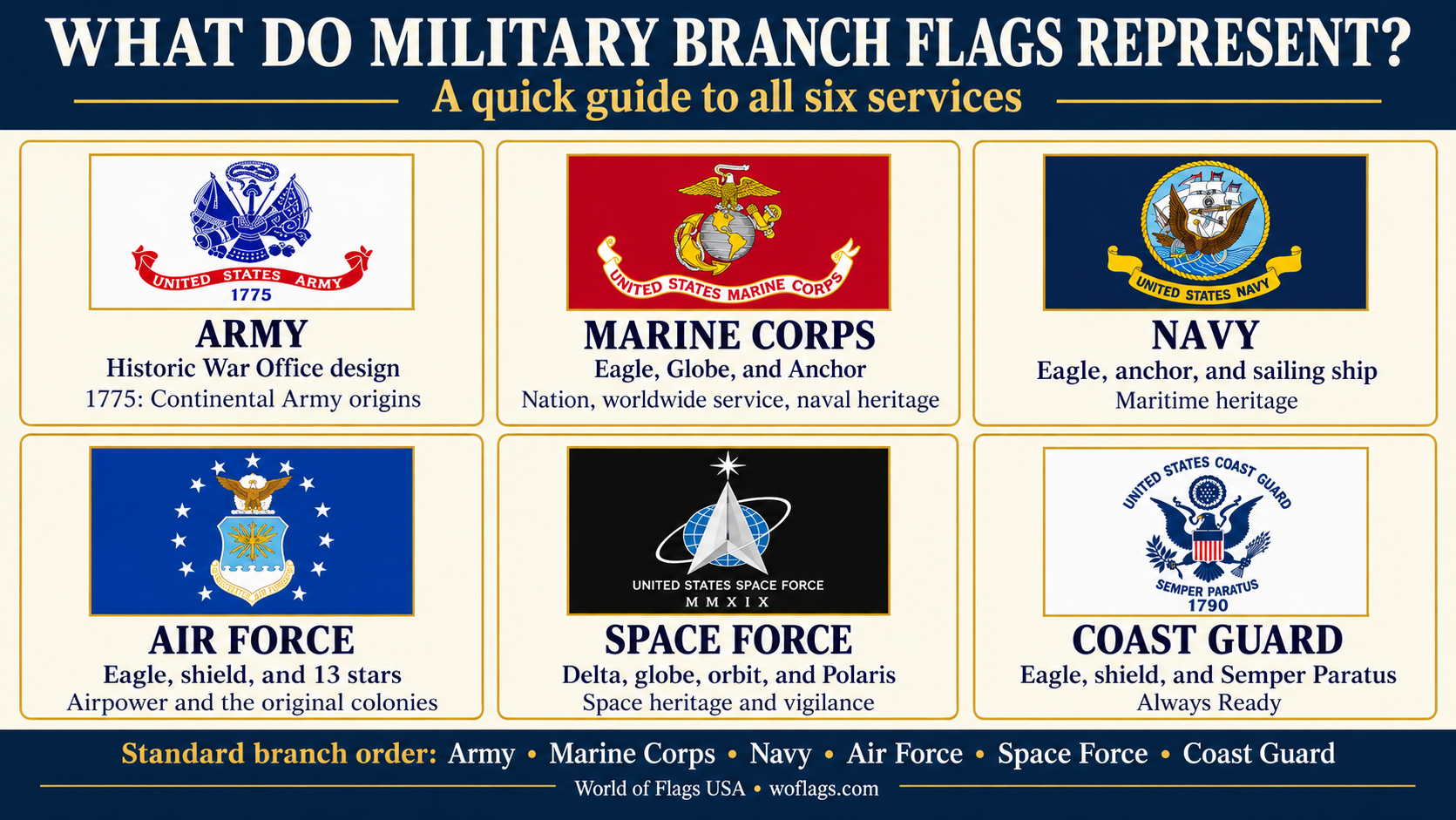
The Army flag has a white background, a blue design based on the historic War Office seal, a scarlet scroll reading “United States Army,” and the year “1775.”
The date points to the establishment of the Continental Army. The flag itself was publicly unfurled in 1956, so the date printed on it identifies the service’s beginning rather than the flag’s introduction.
Its central design includes historic military equipment and symbols associated with the Army’s early identity. Together, these details connect today’s Army with its Revolutionary-era roots.
On ceremonial displays, campaign streamers attached to the staff recognize military campaigns. They carry their own colors, names, and dates; they are separate from the design printed or embroidered on the flag.
For an Army veteran’s home or recognition event, this flag offers a direct connection to the service’s long history.
Also Read: Printed vs. Sewn American Flags: What Is the Difference?
What Does the Marine Corps Flag Represent?
The Marine Corps flag features a scarlet background and the Eagle, Globe, and Anchor emblem. A scroll beneath the emblem identifies the United States Marine Corps.
Each part of the emblem carries meaning. The eagle represents the nation Marines serve. The globe reflects worldwide service, and the fouled anchor connects the Corps with its naval heritage. “Fouled” describes the rope wrapped around the anchor.
The motto “Semper Fidelis” means “Always Faithful.” It expresses the enduring loyalty associated with being a Marine.
Scarlet and gold are the Corps’ official colors. The familiar scarlet flag design was adopted in 1939, following earlier versions used throughout Marine Corps history.
When choosing this flag, check that the emblem, lettering, and colors match the intended design. Small details matter when the person receiving it knows the symbol well.
Also Read: Embroidered vs. Printed Stars on an American Flag
What Does the Navy Flag Represent?
The Navy flag places the central imagery of the Department of the Navy seal on a dark blue background, above a scroll reading “United States Navy.”
Its imagery includes an eagle, an anchor, and a sailing ship. These elements connect the design with the nation and the Navy’s maritime heritage. The official Navy flag was authorized in 1959.
The branch flag should not be confused with the national ensign or the Navy jack. The national ensign is the American flag flown by a vessel; a jack is a separate flag used under naval customs.
The Navy branch flag serves a ceremonial and representational purpose. Seeing an anchor on a flag does not automatically mean you are looking at the official Navy flag.
For a retirement celebration or veterans’ gathering, confirm that the selected design represents the recipient’s service rather than a different naval symbol.
Also Read: Nylon vs. Polyester American Flags
What Does the Air Force Flag Represent?
The Air Force flag features its crest and shield on a blue background, surrounded by thirteen white stars.
The stars represent the original thirteen colonies. The grouping of three stars at the top reflects the Departments of the Army, Navy, and Air Force.
The bald eagle represents the United States and its airpower. The clouds behind it express the emergence of a new sky associated with the Department of the Air Force. The shield’s thunderbolt and flames represent aerospace striking power.
The flag was adopted in 1951, after the Air Force became a separate service in 1947.
Buyers may also encounter flags featuring the modern Air Force symbol. Those designs can express support, but they differ from the official crest-and-shield branch flag. Review the product photograph and description before ordering for a coordinated service display.
Also Read: Grave Markers for Veterans, Firefighters, and Police
What Does the Space Force Flag Represent?
The Space Force flag has a black background and imagery drawn from the service’s seal, including a delta, globe, elliptical orbit, Polaris, and star clusters.
The delta reflects the service’s space heritage and connection with space vehicles. The globe and orbit connect its responsibilities with Earth and the space domain. Polaris, the North Star, represents a guiding light and continuing vigilance.
Beneath the central imagery, the service name appears above “MMXIX,” the Roman numerals for 2019, its founding year. The flag was unveiled in 2020.
Space Force is a separate military service within the Department of the Air Force. Its distinct flag recognizes that identity.
If you are completing an older five-branch display, check whether Space Force needs to be added so the display represents all six services.
What Does the Coast Guard Flag Represent?
The Coast Guard ceremonial flag, also called its standard, has a white background with a blue eagle and a shield featuring red and white stripes.
Its inscriptions include “United States Coast Guard,” “Semper Paratus,” and “1790.” The motto means “Always Ready,” and the date recognizes the service’s Revenue Cutter Service roots.
The standard represents the Coast Guard at ceremonies and other formal displays. It differs from the Coast Guard ensign, which has sixteen vertical red and white stripes and serves a distinct identifying role.
This is an easy purchasing mistake: both designs are connected with the Coast Guard, but they are not interchangeable for every purpose.
For a display recognizing military branches, ask for the Coast Guard standard and compare the product image with the intended ceremonial design.
How Should Military Branch Flags Be Displayed Together?
For a standard joint-service display, the order of precedence is Army, Marine Corps, Navy, Air Force, Space Force, and Coast Guard.
Do not rearrange the branches solely by their founding dates. Established precedence accounts for service history and organizational relationships.
When the American flag is included, give it the position of honor. In a simple straight row facing an audience, that is ordinarily the viewer’s far left. A stage, procession, crossed-staff arrangement, or other setting can require different placement.
For an official ceremony, have the host’s protocol office or color guard confirm the arrangement. The Coast Guard’s placement can change when it operates as a service in the Navy.
Our American Flags Guide and Flag Sets and Poles Guide can help you plan the physical display.
How Do You Choose a Military Branch Flag?
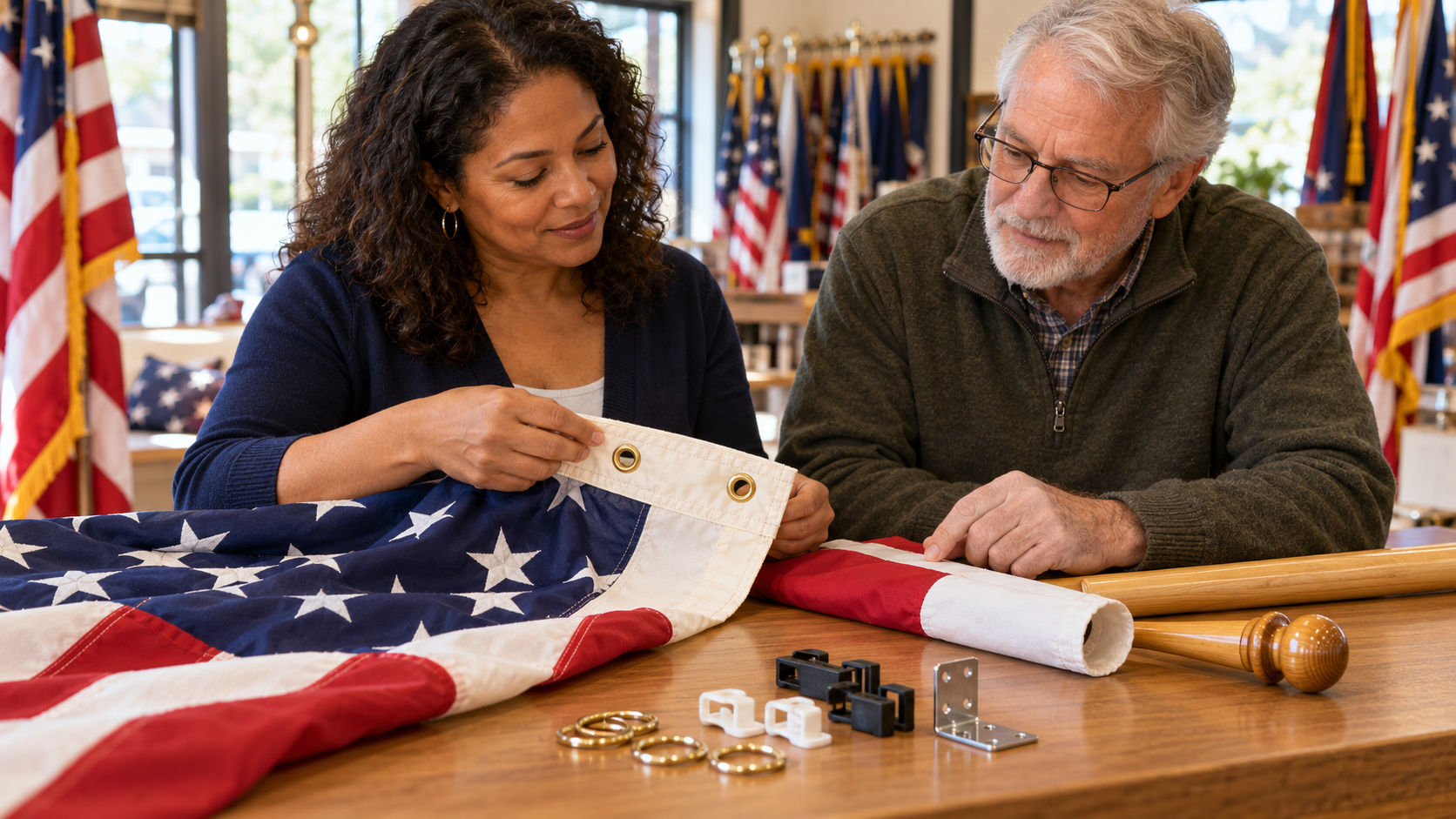
Begin with the branch, the setting, and the intended use. A porch flag, tabletop gift, and indoor ceremonial flag need different sizes and finishes.
Check the following before ordering:
- Design: Confirm the correct branch emblem, wording, colors, and date.
- Material: Choose fabric intended for the actual indoor or outdoor setting.
- Attachment: Match grommets or a pole sleeve to the display hardware.
- Size: Leave room for the flag to hang or move without contacting nearby surfaces.
- Finish: Confirm whether the display calls for fringe or a plain edge.
Use our Flag Sizing Guidelines and Flag Accessories Guide to check compatibility.
Country of manufacture is a separate question. A military design does not establish where a flag was made. Read What Makes an American Flag Truly Made in the USA? and request details for the exact product.
Browse the World of Flags Catalog or ask for help confirming a suitable option.
Common Misunderstandings About Military Flags
A date on a branch flag does not necessarily identify when that flag design was adopted. Army “1775,” Coast Guard “1790,” and Space Force “MMXIX” refer to service origins.
Fringe is a finishing detail used on many ceremonial flags. It does not create another military branch or explain the meaning of the central emblem.
The thirteen stars on the Air Force flag represent the original colonies. They should not be confused with the fifty state stars on today’s American flag. Our guide to American Flag Stars and Their Meaning explains that distinction.
Finally, proper display involves maintenance. Check fabric, stitching, and attachments regularly. If your display includes the American flag after dark, review How to Light Your Flag at Night.
Frequently Asked Questions
1. How Many U.S. Military Branch Flags Are There?
There are six military branch flags: Army, Marine Corps, Navy, Air Force, Space Force, and Coast Guard. Unit flags and other military flags are separate categories.
2. What Does the Army Flag’s 1775 Date Mean?
The year 1775 recognizes the establishment of the Continental Army. It does not identify when the Army flag was introduced; the flag was publicly unfurled in 1956.
3. What Does the Marine Corps Eagle, Globe, and Anchor Mean?
The eagle represents the United States, the globe reflects worldwide service, and the anchor represents the Marine Corps’ naval heritage.
4. Is the Navy Flag the Same as the Navy Jack?
No. The Navy branch flag represents the service. The Navy jack is a separate flag used under naval customs.
5. What Do the Air Force Flag’s Thirteen Stars Represent?
The thirteen stars represent the original thirteen colonies. The three-star grouping at the top reflects the Departments of the Army, Navy, and Air Force.
6. What Does MMXIX Mean on the Space Force Flag?
MMXIX is the Roman numeral for 2019, the year the Space Force was established. Its flag was unveiled in 2020.
7. What Does Semper Paratus Mean?
Semper Paratus means “Always Ready.” It is the Coast Guard motto and appears on its ceremonial standard.
8. What Is the Standard Order of Military Branch Flags?
The standard joint-service order is Army, Marine Corps, Navy, Air Force, Space Force, and Coast Guard. Confirm protocol for official events and special circumstances.
9. Can Civilians Display Military Branch Flags?
Yes. Civilians commonly display military branch flags to recognize service, honor veterans, or support military family members.
10. Are Military Branch Flags Automatically Made in the USA?
No. A military branch design does not establish a flag’s country of manufacture. Check the specific product’s label and manufacturer information.

What You Should Do Next
Choose the branch you want to recognize, then confirm the design, size, material, and attachment style for your display.
For a multi-branch arrangement, include all six services when appropriate and verify their order before installation.
World of Flags can help you compare flags and display accessories. Call 207-262-8275 or visit World of Flags to discuss your home, business, ceremony, or veterans’ recognition display.
Authority References
Source links for the article’s service history, symbolism, and display guidance.