The first American flag you buy may be for a new porch, a school flagpole, a community ceremony, or a building your organization is proud to open. The product descriptions can make a simple purchase sound complicated: printed stars, embroidered stars, sewn stripes, nylon, polyester, pole hem, grommets. Which details actually matter?
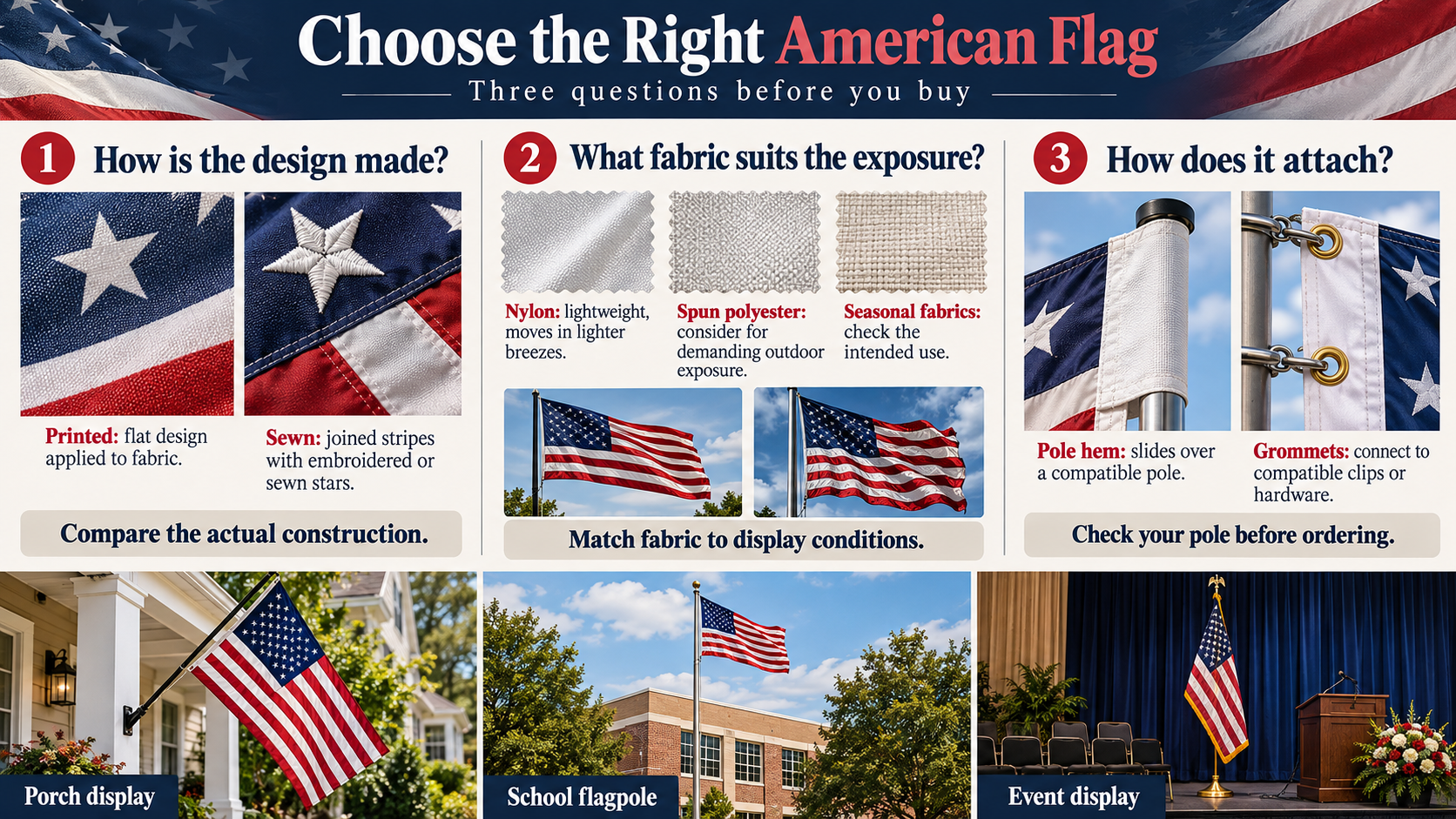
The short answer: A printed flag has its stars and stripes applied to fabric with a dye or printing process. A sewn flag joins separate stripe panels and usually has embroidered or sewn stars on its blue field. Neither construction tells you, by itself, where the flag was made or how long it will last. Match the flag's fabric, finish, size, and attachment to how and where you will display it. Annin, for example, describes a printed polycotton flag for seasonal use and different nylon and polyester lines for regular outdoor display. Annin's outdoor flag guide
What Does “Printed” Mean on an American Flag?
On a printed American flag, the visible pattern is applied to the fabric rather than assembled from separate red and white stripe panels. Depending on the product, the design may be printed or dyed. The flag can still have stitched outer hems, a reinforced fly end, and a sewn heading or sleeve. “Printed” describes the design, not a promise that the entire flag contains no stitching.
Look closely at the blue canton and the stripe boundaries. Printed stars generally sit flat against the cloth. The colored sections do not have the raised seam where individual stripe panels meet. This can make a printed flag lighter and less bulky, depending on the fabric and finish. It can also make it economical to produce. A quality printed flag is a reasonable choice for occasional display, an indoor event, a classroom activity, or a budget that must cover several flags. Check the listing's intended use: a printed flag meant for a few annual events is a different purchase from one specified for continuous outdoor exposure.
Printing itself does not prove poor quality. Dye method, fabric, color fastness, edge stitching, and exposure all matter. World of Flags USA even lists a 3-by-5-foot pole-hem nylon flag with its material field marked “Nylon - Printed” and describes it for outdoor use. This is a useful example of why the product's full specification beats a simple label. Nor is “printed” synonymous with “imported.” Verify country of origin separately.
What Does “Sewn” Mean on an American Flag?
A traditionally sewn American flag has separate fabric stripes joined with stitching. The stars may be embroidered into or onto the canton, or sewn as individual pieces, according to the product. “Sewn stripes and embroidered stars” is a useful description because it tells you exactly which parts use each technique.
Sewn construction gives the stripes a recognizable textured appearance. It involves more cutting and stitching, and often costs more than a comparable printed style. But sewing alone cannot guarantee durability. Inspect the fly end, the outer edge farthest from the pole: that part whips and flexes repeatedly in wind. A well-finished printed flag can be more suitable for a particular job than a poorly finished sewn one. Annin notes that thread and stitching methods at the fly end influence fraying in high wind. Annin flag FAQs
Printed, sewn, and embroidered: a quick comparison
| Feature | Printed design | Sewn stripes with embroidered stars |
|---|---|---|
| Stars and stripes | Applied to the fabric | Stripes joined; stars stitched into or onto the canton |
| Surface | Generally flatter | Visible stripe seams and raised star detail |
| Typical appeal | Simple, often lower initial cost | Traditional finish and more detailed presentation |
| Potential fit | Seasonal, indoor, events, or a product expressly rated for outdoor use | Regular display and prominent ceremonial presentation, subject to fabric and finish |
| What still needs checking | Fabric, color process, fly hem, heading, attachment, origin | Fabric, fly hem, heading, attachment, origin |
These are buying patterns, not universal rankings. Compare actual specifications before choosing.
Which Flag Will Last Longer Outdoors?
There is no reliable lifespan answer from “printed versus sewn” alone. A flag's life depends on exposure to sun, wind, rain, pollutants, nearby branches, frequency of flying, and how its edges are finished. A continuously flown flag will face more wear than a flag displayed only on holidays, even if both are made the same way. Manufacturers do not promise a universal replacement interval for every installation.
For many residential displays, lightweight outdoor nylon offers vivid color, movement in modest breezes, and faster drying after rain. For demanding daily or windy installations, a heavier woven or spun polyester model may make more sense. Annin distinguishes its nylon line for year-round use from its open-weave, two-ply spun polyester line for larger and institutional displays. Some polycotton flags with printed stars and stripes are positioned for seasonal use. These are differences in fabric and intended exposure, separate from how the stars and stripes are made. Annin's material descriptions
Think of a school flag flown every school day on an exposed pole. Its replacement budget should include maintenance and periodic inspection, even if it has sewn stripes and embroidered stars. By comparison, an occasionally displayed homeowner flag might serve its purpose well with a less elaborate construction. The relevant value is cost per satisfactory display, not just the price on the tag. That is a decision framework, not a claim of measured product lifespan.
Which Should You Buy For Your Display?
First-time Homeowners
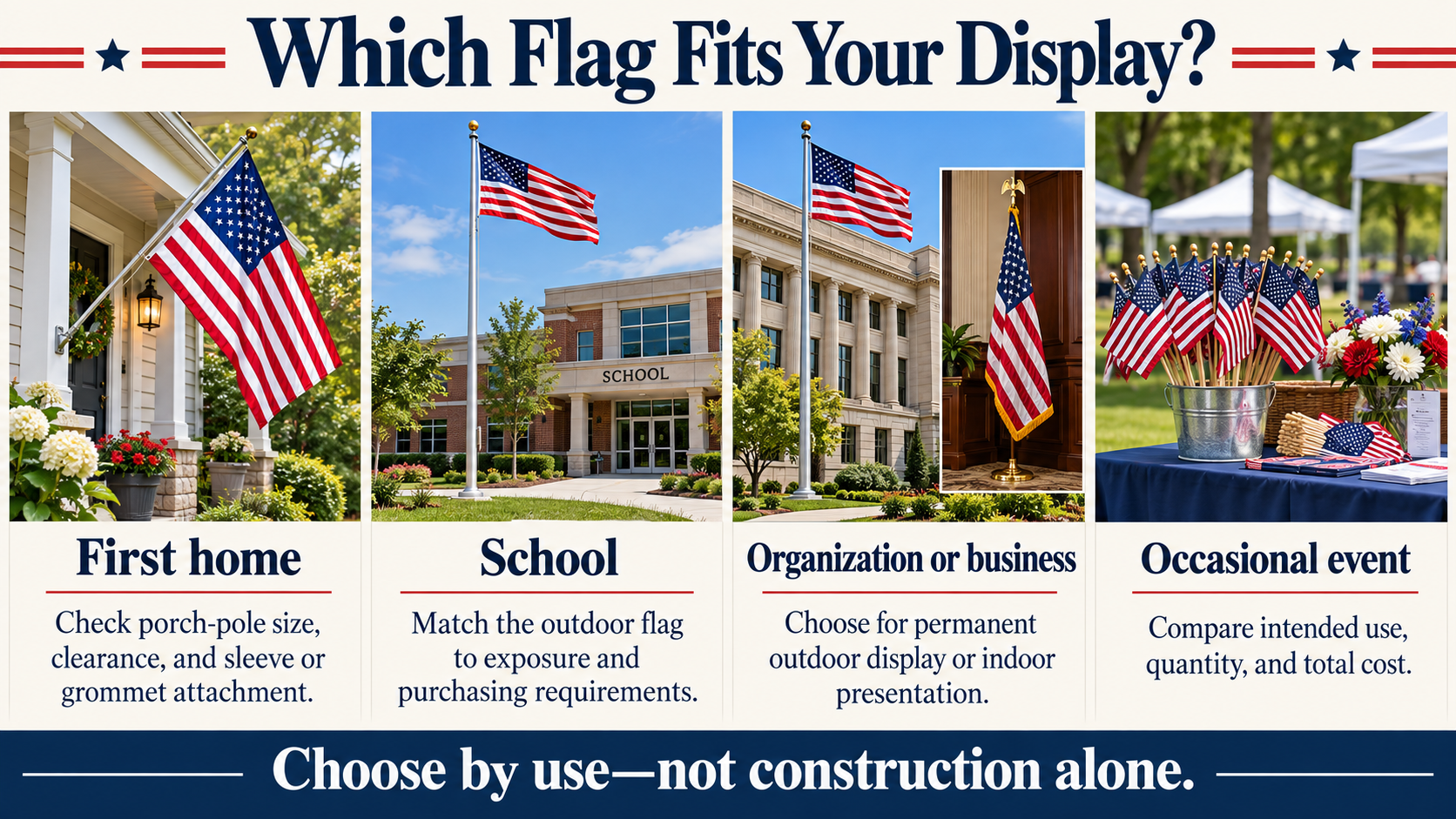
Start with the mounting hardware. A porch pole that accepts a sleeve needs a pole hem; a flag that clips to a halyard commonly needs grommets or the specified heading. Confirm the size and clearance so the flag will not strike the siding, shrubs, or ground. For a common 3-by-5-foot residential display, a sewn nylon model can be an appealing everyday choice; a properly specified printed flag can serve occasional use. World of Flags USA lists both a 3-by-5 Annin Nyl-Brite with sewn stripes and embroidered stars and pole-hem options.
Schools and Campuses
Separate your indoor and outdoor needs. A regularly flown outdoor flag should be chosen for the pole's dimensions, attachment, weather exposure, and the school's replacement schedule. A presentation flag for an auditorium has different hardware and appearance requirements. An embroidered, sewn flag may provide the formal detail wanted for ceremonies; a printed flag may fit a temporary event or classroom display. Confirm any district purchasing specification for size, materials, origin, or finish before ordering multiple units.
Organizations, Businesses, and Community Groups
For a single event, estimate how many flags you need and how they will be used: carried, hung against a wall, flown outdoors, or given to participants. For a permanent building pole, prioritize the pole maker's flag size and hardware guidance, fabric suited to the site, and a plan to inspect the fly end. Request samples or close photographs if a uniform look across locations is important. A flag intended for a stage does not automatically belong on an exposed outdoor pole.
Value-Conscious Buyers
Decide what “value” means for your use. If the flag comes down after each event, a sound printed option may be a sensible purchase. If it flies daily, paying for suitable fabric and finishing may reduce the frustration of a premature replacement. Compare flags of the same size and intended use, and ask whether the price includes the mounting hardware. Do not spend extra for decorative stitching while overlooking an incompatible sleeve or the wrong flag size.
What Should You Check Before Adding a Flag to Your Cart?
- Design construction: Are the stars and stripes printed, dyed, embroidered, sewn, or a combination?
- Fabric: Is it nylon, woven or spun polyester, polycotton, or another material? Does the seller specify the intended display conditions?
- Fly-end finish: How is the outer edge hemmed and reinforced? Can you see it in a product photograph?
- Heading and attachment: Does your pole take a sleeve, grommets, clips, or another mounting arrangement?
- Size and exposure: Will it clear nearby obstacles, and how often will it fly?
- Origin: Is there a clear country-of-origin statement for that particular flag?
- Total purchase: Do you need a bracket, pole, clips, lighting, or replacement hardware as well?
The less obvious insight is that a flag purchase has three independent specifications: how its design is constructed, what material carries that design, and how the finished flag attaches to your display. A product can excel on one and fail your needs on another. Ask those three questions first, then compare price.
Does the Flag Code Require a Sewn American Flag?
No. The federal Flag Code addresses the flag's design and respectful display and care; it does not require civilians to purchase sewn stripes or embroidered stars. Its guidance includes displaying an all-weather flag during inclement weather, illuminating a flag displayed through darkness, and retiring a flag that is no longer a fitting emblem for display. These are separate questions from manufacturing method. See 4 U.S.C. Chapter 1.
If your school or organization has its own procurement or ceremony policy, check that policy as well. A preference for a sewn, American-made flag may be entirely appropriate for a particular institution, but do not mistake a local specification for a universal Flag Code requirement.
Is a Sewn Flag Always Made in the USA?
No. Stitching and origin describe different things. A printed flag can be domestically made, and a sewn flag can be imported. If American manufacture matters to your purchase, look for an explicit claim on the particular product and ask what the claim covers. “Ships from the USA” does not establish domestic manufacture, as the Federal Trade Commission explains in its American flag buying advice.
Learn about World of Flags USA
Common Myths That Lead to the Wrong Flag
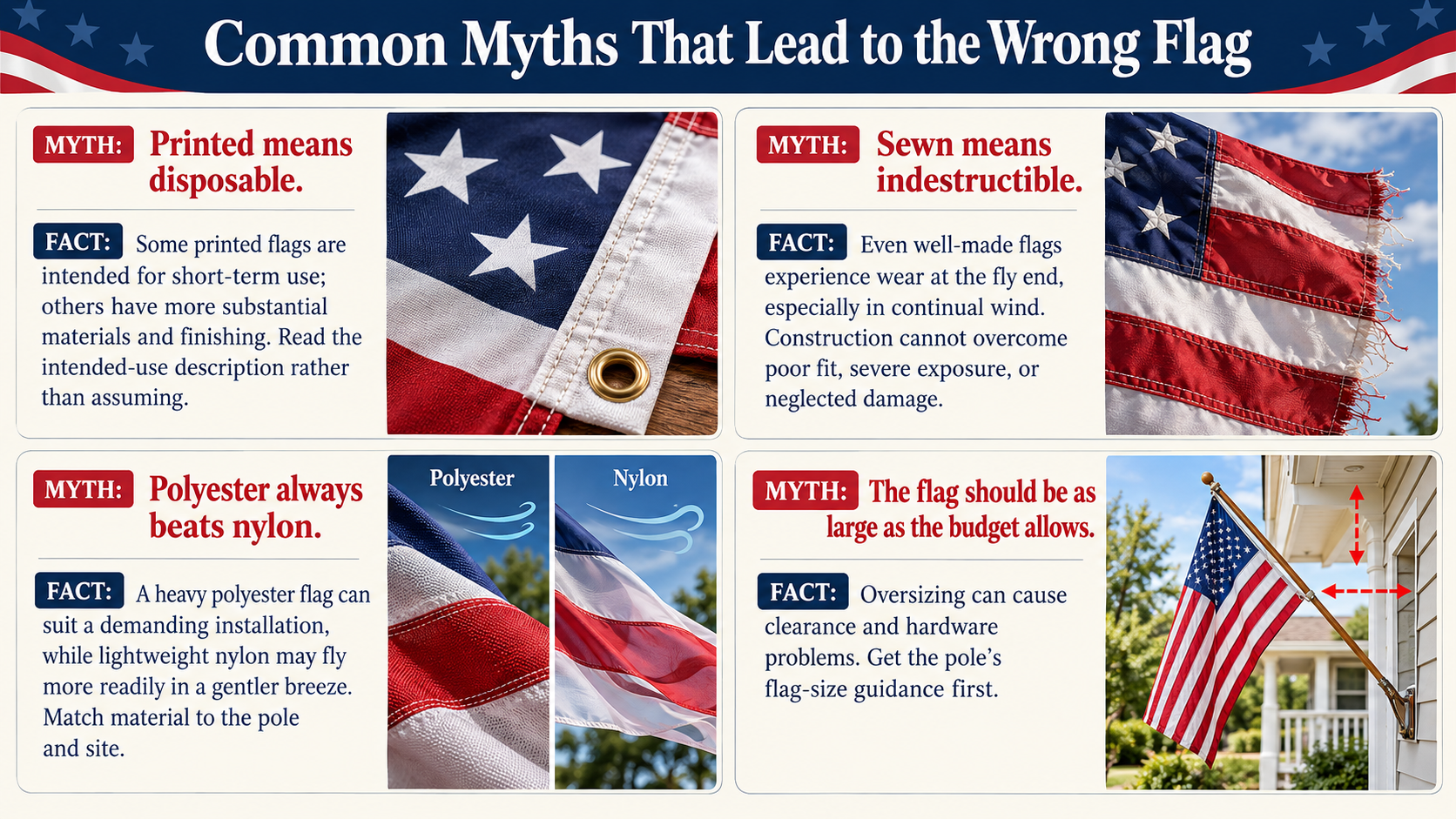
“Printed means disposable.” Some printed flags are intended for short-term use; others have more substantial materials and finishing. Read the intended-use description rather than assuming.
“Sewn means indestructible.” Even well-made flags experience wear at the fly end, especially when exposed to continual wind. Construction cannot overcome poor fit, severe exposure, or neglected damage.
“Polyester always beats nylon.” A heavy polyester flag can suit a demanding installation, while lightweight nylon may fly more readily in a gentler breeze. Match material to the pole and site rather than buying by fiber name alone.
“The flag should be as large as the budget allows.” Oversizing can cause clearance and hardware problems. Get the pole's flag-size guidance first.
Frequently Asked Questions
Are printed American flags acceptable for respectful display?
Yes. Respectful display depends on how the flag is displayed and cared for, not on whether the stars and stripes are printed or stitched.
Are printed flags always less expensive?
Often, but not always. Fabric, size, finishing, maker, and origin affect the price. Compare actual product specifications.
Are sewn stripes stronger than printed stripes?
The stripe technique alone does not settle durability. Fabric, seams, fly-end reinforcement, and weather exposure matter more to the practical choice.
What are embroidered stars?
They are stars formed with stitching on the blue canton. They are distinct from flat printed stars and from separate sewn-on star pieces.
Can I fly a printed flag outside?
Yes, if its product specifications support outdoor use. An inexpensive seasonal printed flag may not be the best choice for continuous exposure.
Is nylon or polyester better for an outdoor flag?
Nylon often moves easily in lighter wind. Heavier spun or woven polyester can suit more demanding exposure. Check the particular flag and pole specifications.
Which construction is best for a school?
Choose separately for the outdoor pole, indoor presentation, and events. Check district purchasing requirements and the flag's size, attachment, fabric, and origin.
Does a sewn flag have to have embroidered stars?
No. Ask exactly how the stars are made. A listing may describe sewn stripes with embroidered stars or another combination.
Does “Made in USA” follow from sewn construction?
No. Confirm the origin claim for the specific flag; construction method does not establish where it was manufactured.
How do I know when to replace a flag?
Inspect it regularly for serious fraying, tears, and fading. Retire it respectfully when it is no longer a fitting emblem for display, rather than relying on a fixed calendar date.
What Should You Do Next?
You do not need to be a flag expert to make a thoughtful first purchase. Measure the display, note how often the flag will fly, and decide which details matter most to you: traditional sewn appearance, an economical event flag, or fabric suited to steady outdoor exposure. Then check construction, material, and mounting together. This short process prevents the most common mistake: buying a beautiful flag that does not suit the pole or the conditions.
Browse American flags at World of Flags USA or explore flag sets and poles. If a school, organization, or first-time homeowner needs help matching a flag to an existing display, call 207-262-8275 for practical guidance. The right flag is one you can display with confidence, maintain with care, and replace when its service is complete.