


Three-Flag Displays for Businesses: Placement, Poles and Planning
A well-planned flag display can make a business entrance feel established, welcoming, and connected to its community. Three flags give you room to express national pride, local identity, and your organization’s purpose. But buying three matching flags is only one part of creating a professional result.
The arrangement needs to suit the flags you choose, the poles already on the property, and the weather those poles face. A display outside a sheltered office in Bangor has different practical demands from one beside an open waterfront parking lot or a busy hotel driveway.
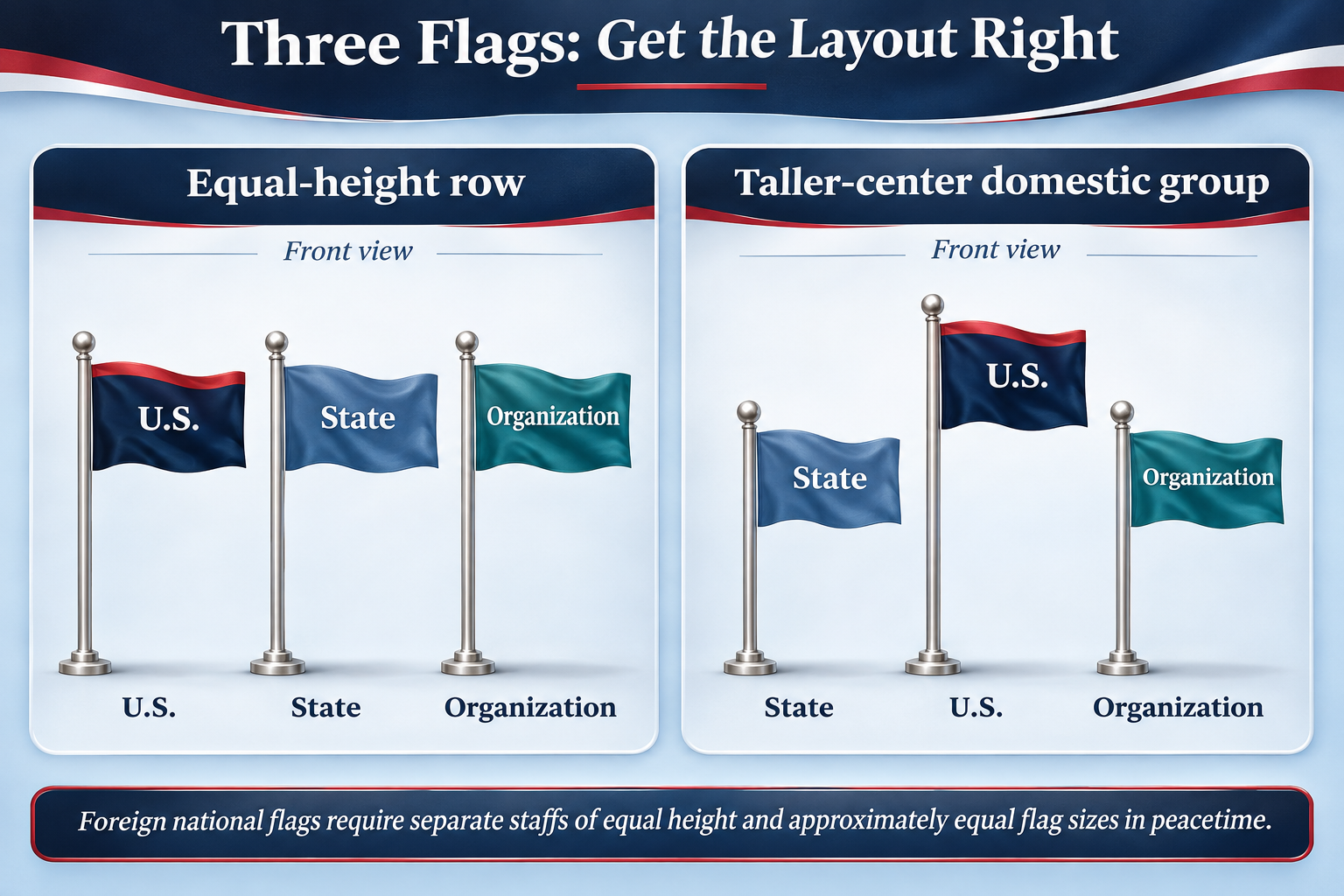
Start with the layout: for a straight row of three equal-height poles, the U.S. flag belongs at the viewer’s left when facing the designated front of the display. For a domestic grouping with a taller center pole, it belongs in the center at the highest point. When foreign national flags are included, equal-height national staffs and approximately equal national flag sizes apply in peacetime. [1, 4, 5]
This guide explains how to plan the arrangement, choose compatible equipment, and make the display manageable after opening day.
Choose what your three flags should represent
Begin by writing down the purpose of the display. Is it a permanent welcome at your headquarters? A civic display outside a public-facing institution? A tribute connected to your organization’s mission? A clear purpose makes the third flag easier to choose and prevents the display from becoming a rotating collection of unrelated messages.
| Display concept | Good planning question |
|---|---|
| U.S., state, and company flags | Does the company flag have an outdoor design that reads clearly from the main approach? |
| U.S., state, and municipal flags | Have you confirmed the approved designs and the property owner’s display policy? |
| U.S. flag with two foreign national flags | Can the site accommodate equal-height national staffs and approximately equal flag sizes? |
| U.S., state, and a remembrance or service flag | Does the chosen tribute flag bring additional protocol or institutional requirements? |
A company flag works best when someone can recognize it while moving past the building. Small lettering, complicated taglines, and a full brochure’s worth of information rarely serve that purpose. If a custom flag is part of your plan, ask whether custom production is available and review the artwork requirements before making the rest of the order dependent on it.
Explore New England state flag options when regional identity is central to the display. If your third flag honors a service or remembrance tradition, review the specialty and honor flag guide before choosing its place.
Use the correct flag order for your pole arrangement
Three poles of equal height
For a straight row, use the U.S. flag’s position of honor at the observer’s left. Establish the primary viewing side first; a photograph from behind the poles reverses the apparent order. Mark the front on your site sketch so purchasers, installers, and maintenance staff use the same reference.
A taller center pole
For a group of domestic flags, place the U.S. flag in the center at the highest point. Do not transfer this arrangement to a display of national flags from multiple countries.
Foreign national flags
National flags use separate staffs of equal height, with flags of approximately equal size, in peacetime. A taller-center arrangement is unsuitable if it puts one nation above another. Confirm protocol for the complete set before installation.
Practical tip: keep a labeled photograph of the approved display with the replacement-flag inventory. When a new employee takes over the task, a photograph is clearer than an instruction that simply says “put the American flag on the right.”
Design around the site, not just the building’s symmetry
The middle of a facade may look like an obvious place for a display. It may also be where guests line up, where snow gets piled, or where a delivery truck needs turning space. Walk the site with the person who manages daily operations before selecting the pole locations.
- Main approach: note where drivers and pedestrians first see the building.
- Open space: look beyond the pole bases to the area the flags can occupy as wind shifts.
- Utilities and access: identify overhead obstructions and arrange underground utility locating before excavation.
- Building clearance: account for canopies, gutters, signs, trees, and nearby walls.
- Winter use: identify plow routes, snow storage areas, and places staff cannot readily reach after a storm.
- Property requirements: confirm landlord approval, local permitting, and applicable site restrictions.
For example, a landscaped island may look attractive in summer but require staff to cross an icy driveway to lower flags in winter. Moving the display closer to a maintained walkway may produce a more dependable result than choosing the most symmetrical location.
Ask the installer to assess the full display area. A flag can clear a wall when hanging still and strike it when extended. A tree that seems distant from the pole base may still intrude into the fabric’s path. Planning for movement protects the appearance of the display and reduces avoidable replacement costs.
Choose flag sizes that work with the actual poles
Large flags can improve visibility, but size is an equipment decision as well as a visual one. Start with the pole’s manufacturer, model, exposed height, and published flag limits. If those details are missing, collect photographs and any available installation records before ordering larger flags.
The American flag selection guide can help you compare available sizes and construction. Use general sizing charts as a starting point for a conversation, then check the exact pole specification.
A useful purchasing question is: “Can this pole carry this flag, in this fabric, at this site?” That is more informative than asking what size flag usually goes on a pole of a certain height.
Also check proportions across the display. Flags with different shapes can look quite different even when their nominal heights match. Lay out the proposed dimensions on paper before ordering. For national flags, preserve the applicable approximately equal-size protocol rather than enlarging one merely to balance a logo.
If a proposal includes two flags on one pole, ask for confirmation that the pole is suitable for the combined load. Adding another flag is not simply an extra pair of clips.
Plan spacing for moving fabric
Three pole bases can be evenly spaced and still produce a cluttered display. The flags need room to move without repeatedly catching on neighboring equipment or striking nearby objects.
Do not choose a universal pole-spacing number from a picture online. Ask the installer to consider flag length, pole movement, prevailing and changing wind directions, and the site’s clearances. Use the largest flag planned for the display, including occasional ceremonial substitutions, when discussing the layout.
Consider a business that normally flies three modest flags but switches to much larger flags for a holiday weekend. If the pole selection and spacing were based only on the everyday set, the holiday arrangement may introduce a problem the original installation never addressed.
A clear site sketch should show pole locations, intended flag sizes, the front viewing side, nearby objects, and the maintenance approach. Keep the sketch with the equipment records so future changes can be checked against the original plan. When reviewing an older installation, start with the flagpole selection guide to help identify which system your records describe.
Compare fabric and construction before buying a matching set
Matching colors and dimensions do not guarantee matching performance. Compare the product specifications for each flag, especially if the three designs come from different manufacturers.
Ask the supplier about fabric weight, intended exposure, drying characteristics, stitching, and replacement availability. Nylon and polyester product names cover different constructions; the useful comparison is between the specific items being quoted. Check their compatibility with the poles rather than assuming a heavier product is automatically the right upgrade.
For a Maine business, describe the setting plainly: an open coastal site, an exposed roadside lot, a sheltered courtyard, or an entrance affected by gusts around surrounding buildings. Those details help the supplier recommend a practical starting point.
Ask about country of origin separately from durability. If American manufacturing is part of your purchasing requirement, the guide to what makes an American flag truly made in the USA explains why the specific product’s sourcing matters. A purchasing file should identify the actual item being ordered rather than rely on a general brand description.
Make the poles and hardware part of the same decision
A professional display depends on the parts that customers rarely notice: the rope, attachments, rotating components, access mechanisms, and mounting system. Start with the flag sets and poles guide to identify the general type of equipment involved.
| Item | What to confirm before ordering |
|---|---|
| Pole and foundation | Model, condition, intended flag load, exposure, and installer requirements |
| Halyard or lifting system | Compatibility, condition, access method, and replacement procedure |
| Snaps and attachments | Fit with the flag heading and the specified pole system |
| Rotating top assembly | Correct component for the pole and the manufacturer’s service instructions |
| Cleat or access door | Practical staff access and control of keys or operating tools |
| Lighting | Nighttime flag visibility, reliable operation, and service access |
The flag accessories and terminology guide helps purchasers identify parts before requesting replacements. A photograph of the attachment is often more useful than an approximate description such as “the little clip at the top.”
For an existing installation, distinguish a worn flag from a hardware problem. If new fabric repeatedly catches or wears in one spot, investigate the contact point rather than repeatedly ordering replacements. Suspected structural damage or inaccessible components call for qualified assessment.

Include lighting and weather procedures in the plan
The Flag Code allows overnight U.S. flag display when it is properly illuminated. Check the actual result after dark: a bright entrance sign or parking lot does not automatically mean the flag is visibly lit. If dependable lighting is unavailable, assign daily raising and lowering.
For weather, the Code provides an inclement-weather exception for all-weather flags. That designation should not replace the pole manufacturer’s operating limits or a plan for high wind, snow, and ice. Decide who monitors conditions, who can lower the flags, and where equipment instructions are kept. [2]
Make that plan workable when the usual employee is absent. A storm procedure that depends on one person having the only access key is fragile. Keep the backup operator informed, and arrange service when a problem prevents normal operation.
Evaluate the display after dark and after weather changes, from a place you can reach safely. Staff should not attempt pole repairs during a storm or force frozen operating equipment. Record the issue and arrange the appropriate service.
Set a maintenance routine someone can actually follow
Good upkeep begins with a named owner. Assign responsibility to a role, identify a backup, and include the display in the property’s regular opening or grounds checklist.
Look for visible fabric wear, attachment problems, unusual pole movement, and lighting failures. After a significant weather event, reassess the display before assuming it is ready for normal operation. Follow manufacturer instructions for any closer inspection or service.
Keep the U.S. flag clear of the ground and other objects, and avoid arrangements that readily tear or soil it. When its condition no longer suits display, arrange dignified retirement. Keep advertising signs off its staff and halyard.
Store replacement flags with their size, fabric, and purchase details. One spare set can be useful where an extended gap would affect a permanent display, but confirm quantities against budget and expected use. The aim is a manageable replacement process, not an unsupported promise about how long the fabric will last.
Record recurring problems. A note that “the right-hand flag catches the tree when wind comes from the parking lot” gives a supplier or installer something concrete to investigate.
Prepare a complete request for a quote
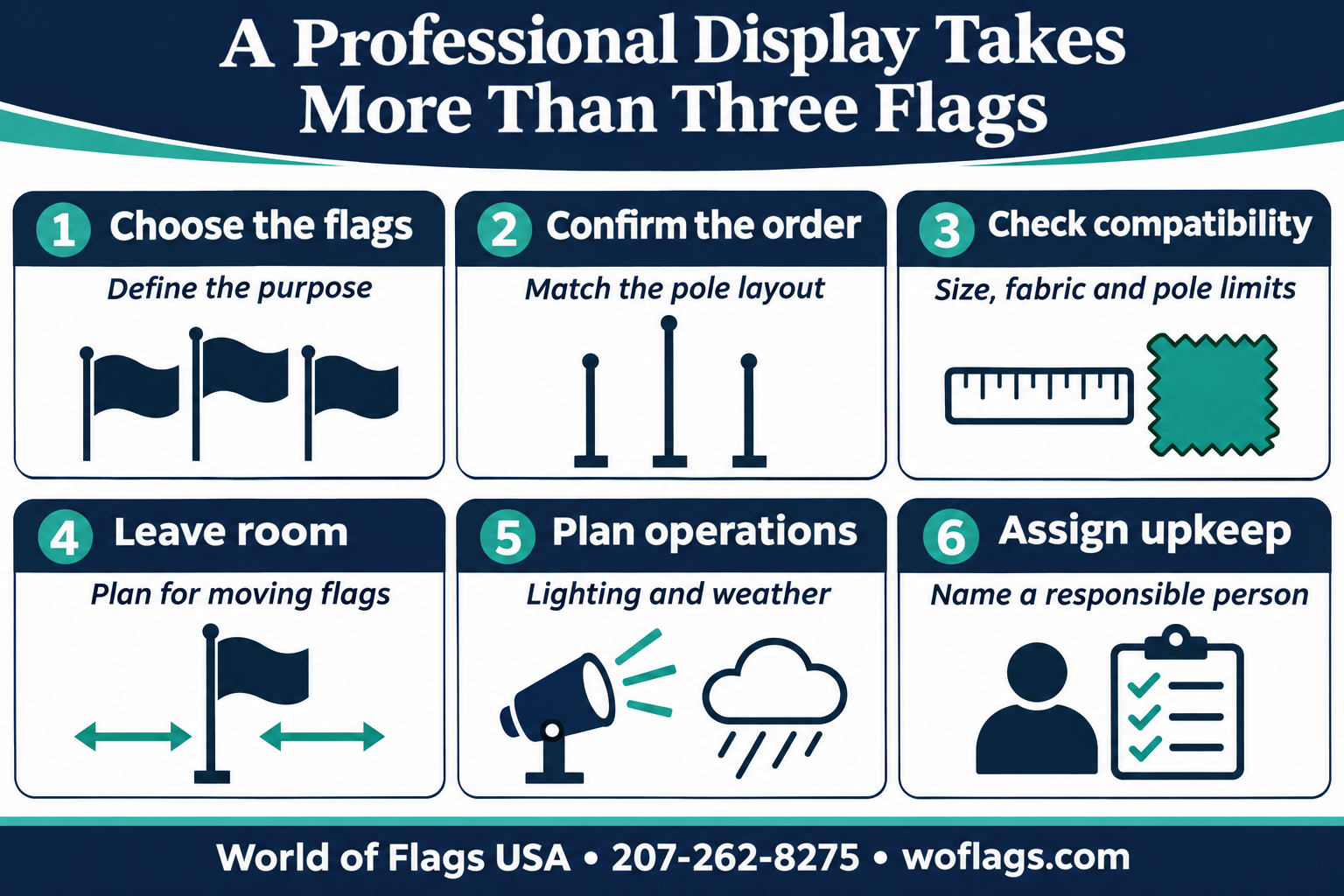
A useful quote request lets suppliers compare the same scope. Separate flag purchases from pole work, installation, and other services so you can see what each proposal includes.
- Describe the display: list the three flags and whether they are permanent or seasonal.
- Document the site: include photographs from the main approach and a simple layout sketch.
- Identify the equipment: provide pole heights, models, existing flag sizes, and attachment photographs where available.
- Explain exposure: describe wind, nearby buildings, coastal conditions, and winter access.
- Define the products: request dimensions, fabric, construction, origin requirements, quantities, and acceptable substitutions.
- Clarify the scope: ask what hardware, shipping, installation, lighting, permits, or site work is included or excluded.
- Plan follow-through: confirm replacement availability and who handles equipment questions.
Compare the initial purchase and the work required to operate it. A lower product price can lose its advantage if the attachment is incompatible or staff cannot service the display. Equally, an expensive flag is not automatically appropriate for every pole or sheltered location.
Use the World of Flags catalog to begin identifying products, then confirm the specific combination before placing an order. Avoid approving a substitution by color and size alone when your specification also includes fabric, attachment style, or origin.
Common mistakes that weaken a three-flag display
- Choosing the center by habit: flag order depends on the arrangement and the flags involved.
- Copying a photograph without identifying its front: reverse viewpoints can reverse the apparent order.
- Buying larger flags before checking equipment: visual impact does not establish compatibility.
- Ignoring movement: still fabric conceals clearance problems.
- Leaving maintenance unassigned: a complete installation still needs an operating routine.
- Treating all-weather as unlimited-weather: product labels do not replace equipment instructions.
The most useful planning habit is simple: approve the arrangement, equipment, and operating plan together. That helps prevent a correct flag order from being undermined by incompatible hardware or an inaccessible location.
Frequently asked questions
Where does the American flag go in a three-flag display?
With three equal-height poles in a straight row, place it at the viewer’s left when facing the display from its designated front. In a domestic grouping with a taller center pole, place it at the center and highest point.
Does the American flag always go in the middle?
No. A taller-center domestic grouping and a straight row of equal-height poles use different arrangements. Confirm the layout before ordering or moving flags.
Can a business fly a company flag beside the American flag?
Yes. Give the U.S. flag the position of honor and use a separate pole for the company flag. Do not put advertising signs on the U.S. flag’s staff or halyard.
Can I display the U.S., Maine, and Canadian flags together?
Yes. The U.S. and Canadian flags need separate staffs of equal height and approximately equal flag sizes in peacetime. Confirm the full arrangement, including the state flag, before setting the display.
What size flags should I buy for three commercial poles?
Choose sizes using the exact pole manufacturer’s limits, the fabric, the number of flags per pole, and the site’s exposure. Matching pole height alone does not establish a safe flag size.
How far apart should three flagpoles be?
There is no universal spacing number that fits every site. Plan for the full flag length, changing wind direction, pole movement, nearby objects, maintenance access, and the installer’s recommendations.
Is nylon or polyester better for a business display?
Compare the particular products and their intended use. Ask the supplier about flag weight, flyability, construction, and exposure, then confirm that the chosen size and fabric suit the pole.
Can a business leave its American flag up overnight?
Yes, if it is properly illuminated during darkness. If reliable illumination is unavailable, plan for daily raising and lowering.
Should an all-weather flag stay up during every storm?
No. An all-weather designation does not establish that a flag and pole can withstand every wind or ice event. Follow the equipment manufacturer’s limits and a site-specific weather plan.
What should I send World of Flags USA before ordering?
Send a photograph from the main approach, the intended three flags, pole heights and model details if known, current flag sizes, attachment details, and a description of the site’s wind exposure.