

POW MIA Flag Meaning: Display Rules & Buying Guide
A black-and-white flag moves beneath the American flag outside a post office, town building, veterans hall or home. Its message is short: “You Are Not Forgotten.” For families still waiting for answers, those words carry lasting weight.
The POW/MIA flag represents prisoners of war and service members missing in action. It is a reminder of the nation's commitment to account for those who have not returned. You do not need to be a veteran to display it respectfully.
If you are planning a display for your home, business, school or community, a few choices matter: the right design, a suitable size, proper placement and equipment that can handle the added flag.
This guide explains those choices in plain language, with special attention to outdoor displays in Maine and New England.
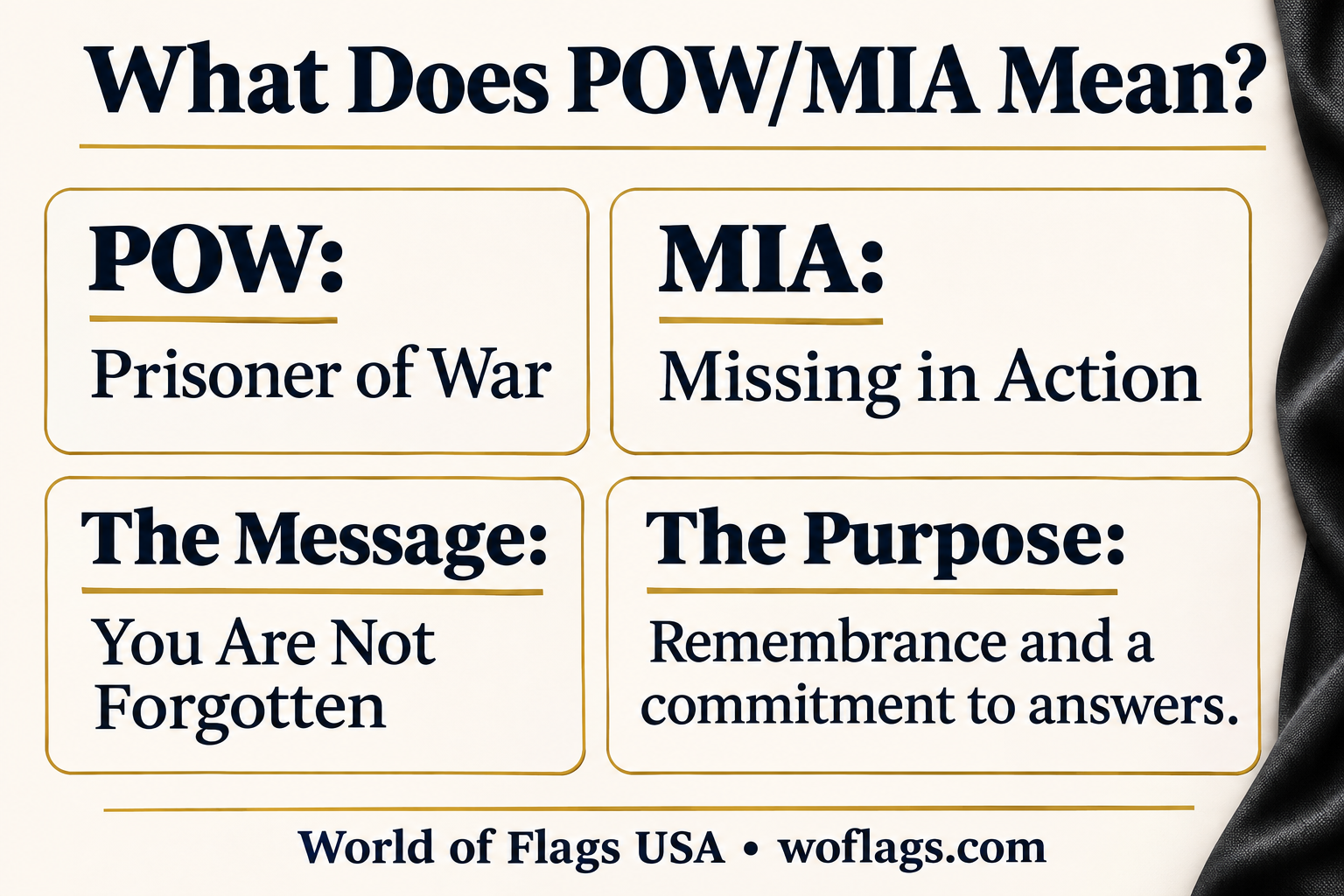
What does POW/MIA mean?
POW stands for prisoner of war. MIA stands for missing in action. The POW/MIA flag calls attention to Americans who were captured or went missing during military service and to the continuing work of accounting for those still unaccounted for.
Its roots are in the Vietnam War era. Federal recognition specifically addresses Americans unaccounted for in Southeast Asia, while the display law also recognizes the nation's commitment to future prisoners of war and missing personnel. See 36 U.S.C. § 902.
The flag serves a different purpose from an Army, Navy or other military branch flag. A branch flag identifies a service. The POW/MIA flag expresses a shared commitment to remembrance and answers. Our Specialty & Honor Flags Guide explains the wider range of service and remembrance flags.
What do the design and words represent?
The familiar design uses a black background and a white emblem. Inside the emblem are a person's profile, a watchtower and barbed wire. “POW*MIA” appears above, with “You Are Not Forgotten” below.
The imagery brings captivity and absence into view. The message asks the public to keep missing Americans and their families in mind. When teaching children about the flag, start with that human meaning: some families are still waiting for information about someone they love.
Avoid presenting the black color as proof that everyone represented has died. The flag expresses remembrance and a commitment to accounting; it does not establish an individual's fate.
For a traditional public display, choose the familiar National League of Families design. Decorative versions can look quite different. Compare a product's artwork with the League’s flag information before ordering for a formal setting.
How did the POW/MIA flag begin?
The flag grew from a family's need to make missing service members visible to the public. Mary Hoff, the wife of a missing serviceman, approached Annin & Company about creating a symbol. Artist Newt Heisley helped develop the design associated with the National League of POW/MIA Families.
The effort took shape in the early 1970s. Congress formally recognized the League's flag in 1990. A further change in 2019 expanded required display at covered federal locations.
The National Park Service history and National League of POW/MIA Families explain its origins. Its lasting importance comes from keeping a difficult, unfinished issue in public view.
Who can fly a POW/MIA flag?
Individuals, families, businesses and community groups can display it. You do not need a military connection or special personal permission to show support.
A homeowner might add one to an existing flagpole. A school might use one during a lesson about service and remembrance. A business might include one in a permanent outdoor display.
The useful question is how to support the display over time. Who will inspect the fabric? Who will lower the flags before severe weather? Who will replace a worn rope or broken attachment?
For a shared property, agree on those responsibilities before installation. A thoughtful display includes a care plan.
When should the POW/MIA flag be displayed?
Private owners can choose daily display or use it for observances and ceremonies. Veterans Day on November 11 is a meaningful occasion to begin, but the flag's message continues throughout the year.
Covered federal locations must display the POW/MIA flag on every day the U.S. flag is displayed. Older guides may mention only six observance days. That is outdated as a summary of the current federal requirement.
The locations listed in 36 U.S.C. § 902 include the White House, Capitol, certain national memorials, national cemeteries, VA medical centers, Postal Service offices and other specified federal facilities.
This federal list does not create a blanket requirement for every private business, school or town hall. Public organizations should also check applicable state requirements and their own policies.
For an event, confirm the display plan before invitations or programs are printed. The person leading the ceremony and the person operating the flagpole should be working from the same instructions.
How to display a POW/MIA flag with the American flag
Start by identifying your setup. One pole, two poles and an indoor stage each need a slightly different arrangement.
Two flags on one pole
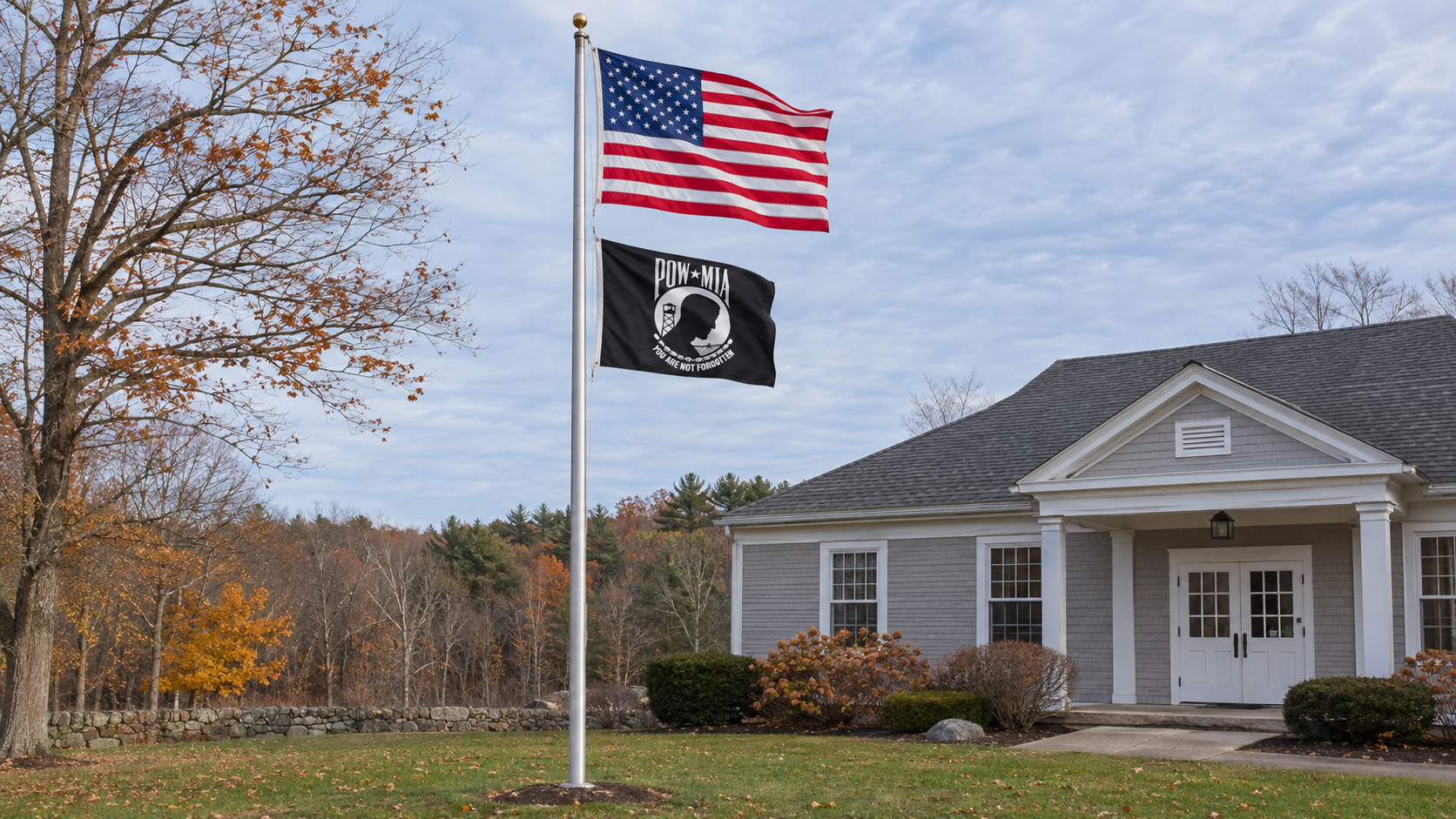
Place the U.S. flag above the POW/MIA flag. The POW/MIA flag should be the same size or smaller. The National League’s protocol supports this arrangement.
Leave enough room for both flags to move without catching on a cleat, roof, shrub or sign. Check the pole manufacturer's limits before adding a second flag. Two small flags can still place a meaningful load on a pole in wind.
Two flags on separate poles
For a simple display of these two flags on equal-height poles, put the U.S. flag in the position of honor: to the viewer's left when facing the display. Do not place the POW/MIA flag above it. The U.S. Flag Code’s placement guidance establishes the U.S. flag's position.
Decide which side is the main viewing side. A display beside a driveway can look reversed to someone standing behind it.
Adding a state flag
A common civic arrangement is U.S. flag, POW/MIA flag, then state flag in order of precedence. Washington's Department of Veterans Affairs describes this setup in its POW/MIA display guidance, including placing the POW/MIA flag under the U.S. flag when a state flag occupies a second pole.
Military installations and other institutions may have specific protocols. Confirm the rules that govern your site before setting a permanent order. Our Guidelines and Regulations for Displaying State Flags offers related background for public properties.
Indoor stages and speaking areas
On a speaker's platform, the U.S. flag belongs at the speaker's right, which is the audience's left. Another flag is placed at the speaker's left. Use stable bases and allow enough space for people to move safely. See 4 U.S.C. § 7(k).
If your ceremony includes foreign national flags, plan that arrangement separately. International displays have their own equal-height principles. Read our A Guide to Properly Displaying Flags of Foreign Countries and confirm the final layout with the event's protocol lead.
Does a POW/MIA flag mean the American flag should be at half-staff?
No. Adding a POW/MIA flag does not itself call for lowering the U.S. flag. A normal remembrance display can fly at full staff.
Veterans Day is not a routine half-staff day under the Flag Code. Follow any applicable official order for the date and location. Memorial Day has a separate rule: the U.S. flag is at half-staff until noon, then raised.
When flags share a pole, preserve their order and enough clearance when lowering them. Review 4 U.S.C. § 7(m) and our Guidelines for Flying the American Flag at Half-Staff before a planned observance.
Can you fly the display at night?
Yes, with a suitable lighting plan. For the companion U.S. flag, the Flag Code permits nighttime display when properly illuminated. See 4 U.S.C. § 6.
Inspect the display after dark. A lamp that lights the upper flag may leave the lower one hidden. As a practical choice, arrange lighting so both flags remain visible.
Check the view from the street or main entrance. Look for shadows from trees, poor aim and a light that stops working before dawn. For a closer look at equipment and placement, read How to Light Your Flag at Night.
How to choose the right POW/MIA flag
The best purchase fits the site. Start with the equipment and viewing conditions, then compare the flag itself.
Choose a size the whole display can support
A 3-by-5-foot flag may be familiar, but it is not the right size for every pole or two-flag setup. Measure your U.S. flag and identify the pole's permitted flag area before ordering.
A smaller companion flag can provide more clearance. It still adds wind load. Ask the pole supplier to assess the combined size when capacity is unclear.
Our Guidelines for Sizing Your Flag for Display is a useful starting point. Treat general size charts as guidance; use the pole manufacturer's limits for the final choice.
Ask what single-reverse and double-sided mean
A single-reverse flag usually shows the design correctly on the front and in reverse on the back. That may suit a display mainly viewed from one direction.
A double-sided flag is made so the message reads correctly from both sides. Construction varies, so ask how the specific product is assembled. Additional fabric can change its weight and movement.
This choice matters for a symbol with words. A flag outside a building may be seen from both directions along the sidewalk. Ask to see photos of each side before ordering.
Match the material to the site
Ask whether the exact flag is intended for outdoor exposure, sheltered use or an indoor presentation. Then discuss wind, rain, sunlight and how often the flag will fly.
For a Maine waterfront, an open roadside lot or an exposed hill, tell the supplier about those conditions. A flag's material name alone does not explain how the finished product will perform. Construction, size, maintenance and exposure all matter.
Avoid buying on a promised lifespan alone. An exposed daily display and a sheltered occasional display create very different demands.
Match the attachment to the pole
Grommets are reinforced holes used with compatible clips or snaps. A pole sleeve slides over a suitable staff. They are different mounting systems.
Before ordering, photograph the existing pole, clips and flag heading. If you are buying for an organization, record the correct attachment in the purchasing notes so the next order matches.

Verify manufacturing origin for the exact product
If U.S. manufacture matters to your order, ask for the maker and origin information for that exact POW/MIA flag. Do not rely only on the seller's address or the origin of another item in the catalog.
Our guide, What Makes an American Flag Truly Made in the USA?, explains the distinction between product construction and manufacturing origin.
A simple plan for schools, towns and veterans groups
A successful order starts with a short site review. Use this checklist before requesting a quote:
- List the locations. Note each pole, indoor stand or ceremony space.
- Record the current setup. Include pole details, flag sizes and attachments.
- Check the requirements. Confirm applicable display rules and institutional protocol.
- Describe the exposure. Include wind, nearby obstacles and nighttime lighting.
- Assign care. Name the person or team responsible for inspection and replacement.
- Confirm timing. Check stock and delivery before announcing an event.
Installing a new pole may raise site or approval questions. Our article on flagpole permits in public areas can help you prepare those questions.
For cemetery projects, check the cemetery's placement and seasonal policies before adding flags or holders. Our guide to veterans grave markers can help with the wider remembrance plan.
Keeping the display in good condition
Inspect the loose outer edge, seams, heading and attachment points regularly. Look for fading that makes the message hard to read, tears, snagging and damaged clips.
Do not leave maintenance until the morning of a ceremony. A quick check a week earlier gives you time to address a worn attachment or order a replacement.
Follow the flag manufacturer's care instructions. Dry fabric fully before storage and check conditions before handling a pole during rough weather. Public facilities should follow their established procedures.
The League recommends replacing worn, faded or tattered POW/MIA flags. For the companion American flag, our guide to respectful American flag retirement explains options when it is no longer fit for display.
Frequently asked questions
What does POW/MIA stand for?
POW means prisoner of war. MIA means missing in action. The flag represents remembrance and the continuing commitment to account for Americans who remain unaccounted for.
Can a civilian fly a POW/MIA flag?
Yes. Individuals, families, businesses and community groups can display a POW/MIA flag respectfully. You do not need to be a veteran.
Where does the POW/MIA flag go on the same pole as the American flag?
Place it below the U.S. flag. It should be the same size or smaller, and the pole must be able to support the combined display.
Is the POW/MIA flag flown only on Veterans Day?
No. Private owners can choose daily display or special observances. Covered federal locations must display it whenever the U.S. flag is displayed.
Do all businesses have to fly a POW/MIA flag?
No. The federal display law applies to specified locations. Public organizations should also check state requirements and their own policies.
Does flying a POW/MIA flag mean the U.S. flag should be at half-staff?
No. The POW/MIA flag does not itself call for half-staff display. Follow the applicable official order or observance guidance.
Should I choose a single-reverse or double-sided POW/MIA flag?
Consider where people will view it. A single-reverse flag usually reads backward on the reverse side. A double-sided flag is made to read correctly on both sides. Confirm the specific construction before buying.
What size POW/MIA flag should I buy?
Choose a size that is no larger than the companion U.S. flag and stays within the pole manufacturer’s limits for the complete display. Check clearance and attachment compatibility too.
Can I leave the flags up at night?
The U.S. flag may be displayed at night when properly illuminated. For a clear two-flag display, check after dark that the lighting makes both flags visible.
When should I replace a POW/MIA flag?
Replace it when fading, tears, worn seams or damaged attachment points leave it unsuitable for a respectful display. Follow the manufacturer’s care instructions and inspect it regularly.

What You Should Do Next
A POW/MIA display is a small daily act with a lasting message. Choosing it should feel manageable, whether you are honoring a family connection, preparing a Veterans Day ceremony or caring for a community building.
Start with a photo of your current setup and the size of your American flag. Share where the display will stand, how often it will fly and whether it needs to read clearly from both sides.
World of Flags USA can help you compare available flags and display equipment. Ask about the size, construction, attachment and origin of the exact product before ordering. If an event is approaching, confirm availability and timing now so there is room to prepare.
Call 207-262-8275 or explore World of Flags USA’s specialty and honor flags to begin planning a thoughtful display.