
 America 250 Flag Guide: Choosing a 1776–2026 Flag for Your Home, Business, or Community
On July 4, 2026, the United States marked 250 years since the adoption of the Declaration of Independence. Known formally as the United States Semi quincentennial and widely recognized as America 250, this historic milestone inspired homeowners, businesses, municipalities, schools, veterans’ organizations, and civic groups across the country to commemorate America’s founding.
Although the official anniversary has passed, America 250 flags remain meaningful symbols of the semi quincentennial era. Many property owners and organizations continue to display them as commemorative pieces, while others are purchasing flags for historical exhibits, civic programs, community spaces, permanent collections, and recurring patriotic events.
An America 250 flag can create a visible connection between the principles declared in 1776, the national reflection surrounding the 2026 anniversary, and the country’s journey into its next 250 years. However, commemorative flags vary considerably in historical accuracy, construction, durability, proportions, licensing, and suitability for different environments.
Choosing the right 1776–2026 flag requires more than selecting an attractive red, white, and blue design. A well-made flag should fit its setting, withstand its expected exposure, remain legible from the intended viewing distance, and complement—rather than replace or diminish—the United States flag.
This guide explains how to evaluate an America 250 flag for a residence, business, public institution, historical display, or community setting—and how to ensure it remains a fitting tribute long after the anniversary itself.
Guidelines for Sizing Your Flag for Display
What Does an America 250 Flag Represent?
America 250 commemorates the 250th anniversary of the Declaration of Independence, which the Second Continental Congress adopted on July 4, 1776. The anniversary therefore relates specifically to the founding declaration rather than the creation of the first official United States flag.
That distinction is historically important. Congress did not adopt the first national flag resolution until June 14, 1777. The resolution called for 13 alternating red and white stripes and 13 white stars on a blue field, but it did not prescribe how the stars should be arranged. Several legitimate 13-star patterns consequently appeared during the Revolutionary period.
The familiar circular 13-star design commonly called the “Betsy Ross flag” became an enduring symbol of the founding era. However, the popular story crediting Betsy Ross with creating the first American flag is not supported by definitive contemporary evidence. Historically responsible sellers and organizations should present it as a traditional commemorative design rather than a conclusively documented first flag.
Most 1776–2026 flags are commemorative banners, not official versions of the United States flag. Their designs may incorporate the dates “1776–2026,” the number 250, stars, stripes, eagles, founding-era imagery, or words associated with liberty and independence.
How Many Stars Are On The American Flag, And What Do They Represent?
Official America 250 Branding Versus Independent Designs
Not every flag celebrating the nation’s 250th anniversary is an official America250 product. America250 branding and its associated graphic assets are connected with the United States Semi quincentennial Commission and supporting organizations. Use of those assets may be governed by trademark, licensing, and brand requirements.
Independent manufacturers may produce original designs commemorating the anniversary, but buyers should not assume that every flag displaying “America 250” is officially licensed, endorsed, or approved.
This distinction is especially important for government agencies, businesses, nonprofit organizations, and event organizers whose flags may appear in advertising, sponsorship materials, broadcasts, or branded public spaces.
Before purchasing a flag represented as official merchandise, ask:
- Is the product officially licensed?
- Who created or authorized the design?
- Can the seller document its licensing claim?
- Does purchasing the flag include any right to reproduce the artwork?
- Are there restrictions on using the design in commercial promotions?
Buying a licensed flag does not necessarily grant permission to place its artwork on shirts, advertisements, signs, or other merchandise. Organizations planning broader use should obtain the appropriate authorization.
How The USA Flag Became A National Icon Of Unity And Freedom?
How to Choose an Effective America 250 Flag Design
A successful flag must communicate at a distance. Fine lettering, crowded illustrations, narrow outlines, and lengthy slogans may look attractive on a product page but become unreadable once the flag is flying above a building or public space.
The strongest designs generally feature bold contrast, a recognizable central element, limited wording, and enough open space to prevent visual clutter. The dates “1776–2026” and any anniversary message should remain identifiable from the flag’s expected viewing distance.
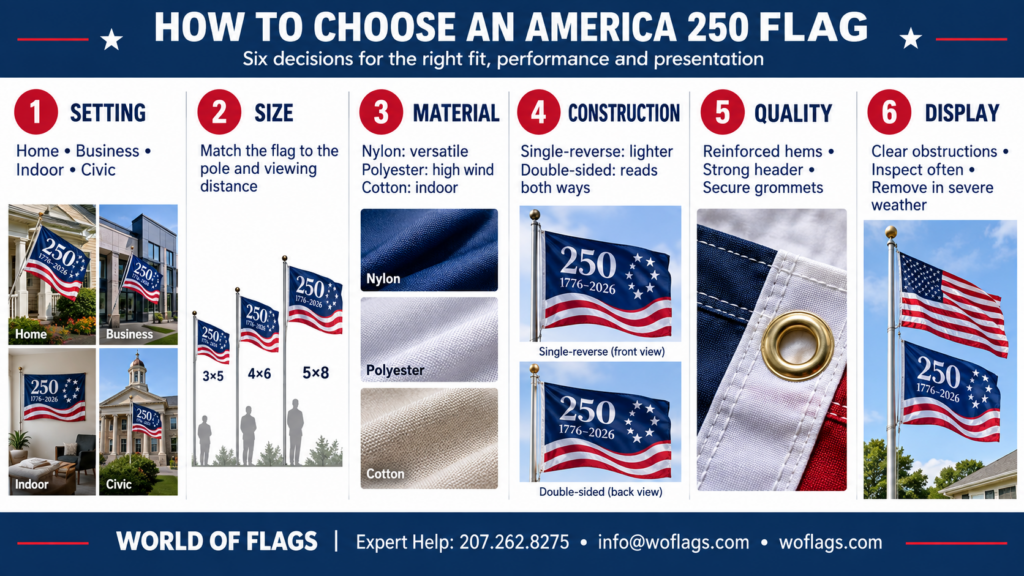
Buyers should also distinguish between single-reverse and double-sided construction.
A single-reverse flag is usually printed on one layer of fabric. The design shows through on the reverse side, where lettering appears backward. This construction is lightweight, economical, and responsive in moderate wind.
A double-sided flag uses two printed panels, often with a liner between them, so wording reads correctly from both directions. It provides a more polished presentation but is heavier, costs more, and may require stronger wind to fly fully.
Single-reverse construction is usually sufficient for a residential porch. Double-sided construction may be worth the investment at a corporate entrance, civic plaza, historical exhibit, parade route, or location where people approach from both directions.
How To Light Your Flag At Night?
Choosing the Right Flag Material
Material affects appearance, movement, lifespan, and maintenance.
Nylon is an excellent general-purpose option for homes, offices, schools, and areas with light-to-moderate wind. It is lightweight, produces vivid colors, dries relatively quickly, and flies in gentler breezes.
Heavy-duty woven polyester is often better for tall flagpoles, open commercial properties, coastal environments, and consistently windy locations. It offers greater strength and abrasion resistance, although its additional weight means it requires more wind to fly freely.
Knitted or economy polyester is frequently used for festivals, parades, promotional campaigns, and temporary displays. It can provide good short-term value, but buyers should not confuse economy polyester with commercial-grade outdoor material merely because both are labeled “polyester.”
Cotton delivers a traditional texture and historic appearance. It is best suited to indoor exhibits, framed presentations, ceremonial occasions, and protected displays. Because cotton absorbs moisture and is more vulnerable to fading and deterioration, it is generally not the best option for continuous outdoor use.
Construction quality matters as much as the fabric itself. Reinforced fly-end stitching, lock-stitched hems, durable headers, corrosion-resistant grommets, and strengthened corners can determine whether a flag lasts for weeks, months, or years.
What Size America 250 Flag Should You Buy?
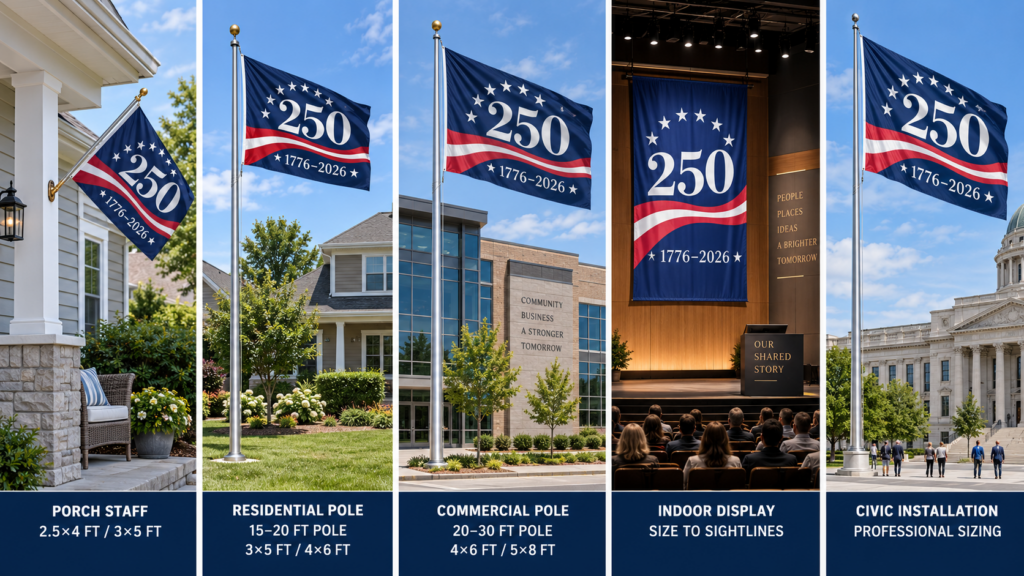
A 3-by-5-foot flag remains the most versatile residential size and works well on many wall-mounted staffs and modest freestanding poles. A 4-by-6-foot flag provides greater visibility on larger homes and many 20-to-25-foot poles. Commercial and civic installations may require 5-by-8-foot, 6-by-10-foot, or larger flags.
Typical starting points include:
- Porch or wall-mounted staff: 2.5 by 4 feet or 3 by 5 feet
- 15-to-20-foot residential pole: 3 by 5 feet or 4 by 6 feet
- 20-to-30-foot commercial pole: 4 by 6 feet or 5 by 8 feet
- Indoor stage or exhibit wall: determined by room size and audience sightlines
- Large civic installation: professionally sized for the pole and site conditions
These are general guidelines, not structural specifications. Flag size must be evaluated alongside the pole, halyard, brackets, fasteners, foundation, local wind conditions, and surrounding clearances.
A larger flag produces substantially greater wind loading. Installing an oversized flag can bend brackets, damage poles, loosen anchors, and create a hazard for people or property. When specifications are uncertain, obtain a professional assessment rather than relying solely on visual preference.
Choosing an America 250 Flag for Your Home
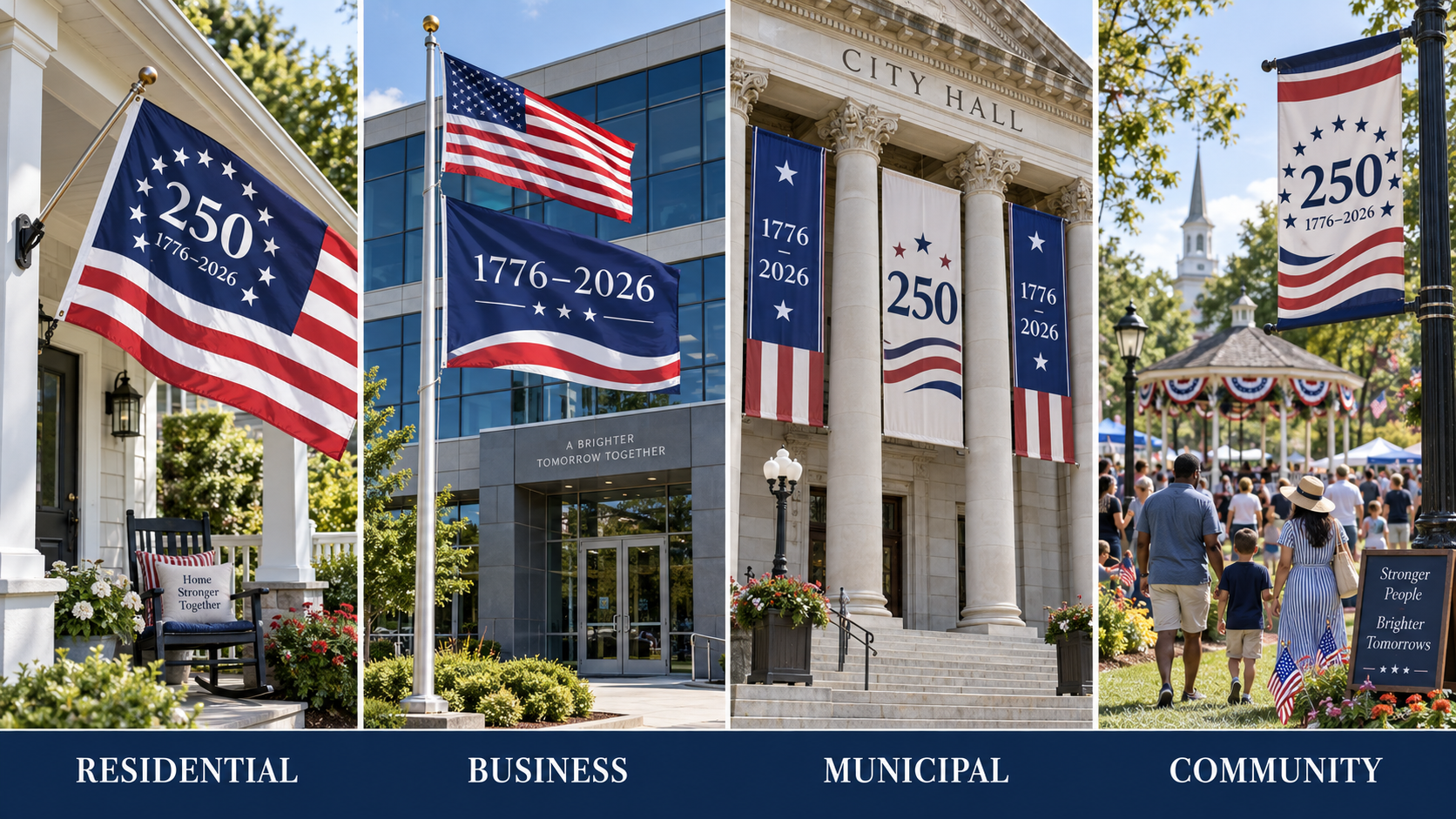
Homeowners may display a 1776–2026 flag on a separate staff, beneath the United States flag on a properly configured flagpole, or as a decorative banner in an appropriate location.
If the commemorative flag shares a halyard with the American flag, the United States flag should occupy the superior position. The anniversary flag should not be displayed above it or presented in a way that could cause it to be mistaken for the national flag.
Before installing a residential flag, determine whether it will clear the roof, siding, gutters, trees, utility lines, and nearby structures. Repeated contact with shingles, masonry, branches, or metal surfaces can quickly fray even premium fabric.
Homeowners should also confirm that the mounting surface can withstand repeated wind loading, exterior lighting is available for nighttime display when appropriate, and the flag can be removed safely during severe weather. Homeowners’ association rules and local ordinances may also affect pole height, flag size, mounting locations, or the number of flags displayed.
Principles and Etiquette for Proper Flag Display
Selecting Flags for Businesses and Commercial Properties
Commercial buyers must balance presentation, safety, brand consistency, and lifecycle cost. A faded or unraveling flag at a prominent entrance can undermine the quality and permanence the commemoration deserves.
Businesses should favor documented materials, reinforced construction, replaceable hardware, appropriate warranties, and a realistic inspection schedule. Organizations managing multiple properties should standardize the design, dimensions, display practices, and replacement criteria across locations.
Country-of-origin claims deserve careful attention. Under Federal Trade Commission guidance, an unqualified “Made in USA” claim generally requires a product to be “all or virtually all” made in the United States. “Designed in America,” “printed in the USA,” and “assembled in the USA” do not necessarily mean the same thing.
Ask where the fabric was woven, where it was printed, where the flag was sewn, and where final assembly occurred. Patriotic imagery alone does not establish American manufacture.
Planning Community and Institutional Displays
Community flag programs require coordinated planning. Organizers should establish a clear visual hierarchy: the United States flag as the primary national symbol, state and municipal flags where appropriate, and America 250 banners as the commemorative layer.
A written display plan should identify:
- Approved designs and licensing status
- Installation sites and responsible departments
- Flag sizes, quantities, and materials
- Pole and bracket conditions
- Nighttime illumination
- Inspection and replacement schedules
- Severe-weather procedures
- Pedestrian and vehicle clearances
- Storage or preservation plans
- Dates for ceremonial or recurring display
Municipalities and institutions may also need to consider procurement policies, engineering requirements, fire codes, right-of-way restrictions, and rules for banners attached to streetlights. Professional review is advisable when flags will be installed above streets, sidewalks, entrances, or gathering areas.
Do We Need A Permit To Install A Flagpole Or Display Flags In Public Areas?
America 250 Flag Etiquette
The United States Flag Code provides nationally recognized customs for displaying and respecting the American flag. It states that the flag is customarily displayed from sunrise to sunset, although it may remain displayed continuously when properly illuminated during darkness. It should generally not be flown during inclement weather unless it is an all-weather flag.
The American flag should not touch the ground, floor, water, or merchandise. It should occupy the position of honor when displayed with other flags, and its union—the blue field of stars—must be oriented correctly.
A separate America 250 commemorative banner is not automatically governed by every provision applying to the official United States flag. Nevertheless, respectful handling is appropriate because the banner intentionally carries national symbolism.
Replace an anniversary flag when it becomes badly faded, torn, or illegible. Do not allow it to remain tangled around a pole or repeatedly strike surrounding structures. Organizations should consult the actual Flag Code and relevant state or local requirements rather than relying entirely on simplified etiquette graphics.
Etiquettes To Dispose Of The American Flag
How to Evaluate Quality Before Purchasing
An informed buyer examines the complete specification rather than judging the product by its online photograph. Important factors include fabric type and weight, printing method, colorfastness, number of stitched rows, header construction, grommet material, corner reinforcement, warranty coverage, and replacement policies.
For custom or bulk orders, request a physical sample. Examine it in natural light, view it from the anticipated distance, and confirm how the design appears from both sides. Approve color, dimensions, stitching, and artwork before authorizing full production.
Extremely low prices may reflect thinner fabric, fewer rows of stitching, weaker hardware, limited ultraviolet resistance, or inconsistent finishing. For extended display, lifecycle value is more important than initial cost. A cheap flag replaced several times may ultimately cost more than a properly constructed product.
Caring for a 1776–2026 Commemorative Flag
No outdoor flag is permanent. Ultraviolet radiation, wind, moisture, road salt, airborne grit, and contact with surrounding surfaces gradually weaken textile fibers.
Inspect the fly end and outer corners regularly because damage frequently begins in those high-stress areas. Follow the manufacturer’s cleaning instructions, use mild products, and allow the flag to dry completely before folding or storing it.
Remove the flag during severe wind, thunderstorms, hurricanes, ice, or other hazardous conditions. Keep a replacement available if the flag plays an important role in scheduled ceremonies. Minor fly-end damage may sometimes be trimmed and professionally re-hemmed before it spreads into the main field.
For long-term preservation, keep the flag away from excessive light, heat, moisture, dust, and insects. Avoid attics, garages, and damp basements. A historically important or signed flag should be stored or framed using archival materials and evaluated by a qualified textile conservator.
When Should You Display an America 250 Flag?
An America 250 flag can continue to be displayed as a commemorative object after 2026, particularly during Independence Day, Flag Day, Memorial Day, Constitution Day, Veterans Day, local heritage festivals, historical exhibitions, and educational programs.
Museums, schools, civic organizations, and municipalities can also use these flags when examining the meaning of the Declaration of Independence, the nation’s development since 1776, and the responsibilities of citizenship during America’s next quarter-millennium.
The strongest displays connect the flag to meaningful programming. Historical exhibits, naturalization ceremonies, veterans’ recognition, volunteer projects, civic discussions, and student programs give the banner a purpose beyond decoration.
Choose an America 250 Flag Worth Preserving
Choosing an America 250 flag can feel unexpectedly complicated. Buyers must navigate competing designs, unclear manufacturing claims, different fabrics, licensing questions, display etiquette, and products that may look nearly identical online while performing very differently in real conditions.
Those details matter because America’s semi quincentennial was a once-in-a-nation milestone. The flags created for it now carry lasting commemorative value, whether they remain in active use or become preserved records of how homes, businesses, and communities marked the occasion.
Begin with the setting. Determine the proper size, material, viewing distance, wind exposure, construction, hardware, historical message, and licensing requirements. Work with a knowledgeable supplier that can answer precise questions and recommend what the installation genuinely needs—without guesswork, inflated claims, or unnecessary upgrades.
The right 1776–2026 flag does more than decorate a property. It preserves a visible connection between the founding generation, the Americans who experienced the 250th anniversary, and the future citizens who will carry the nation toward its next milestone. Choose it carefully, display it respectfully, and preserve it as part of the story America wrote in 2026.
Authoritative References: America250, U.S. Flag Code—Title 4, Chapter 1, Library of Congress—June 14 and the Flag Resolution, Smithsonian National Museum of American History, Federal Trade Commission—Made in USA Standard