
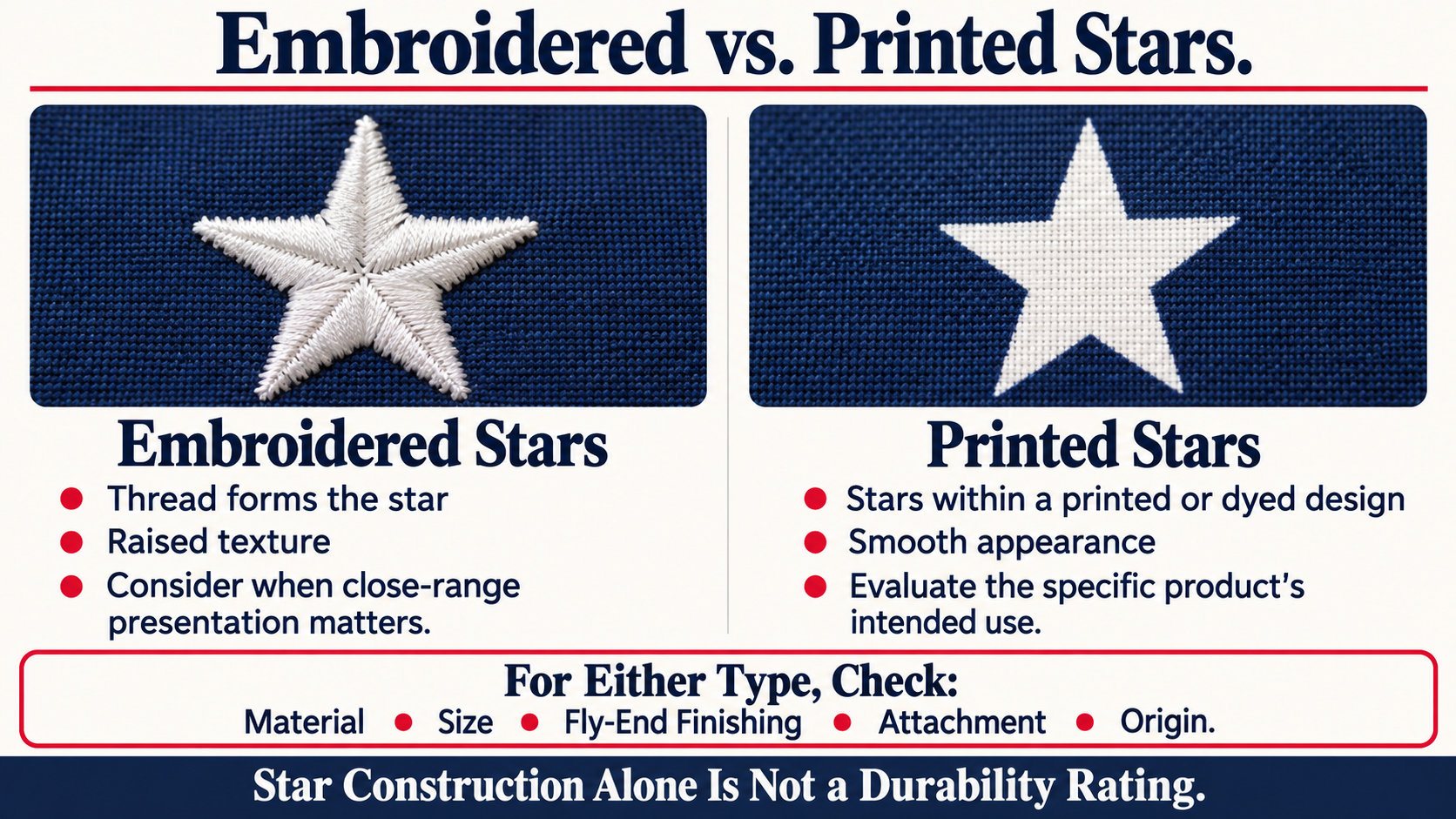
A white star stitched into blue fabric has a different presence from one printed into the design. Up close, the thread catches the light. From across a yard, the difference may be much harder to notice.
That makes embroidered vs. printed stars a question about how you will use and view your American flag—not just which product looks more impressive in a close-up photograph.
For a homeowner choosing a porch flag, an organization refreshing an indoor display, or a committee preparing a ceremony, the best purchase balances appearance, intended use, compatible hardware, and budget.
The Quick Answer: Which Star Construction Should You Choose?
Choose embroidered stars when raised texture and a traditional presentation matter to you. Consider printed stars when a smooth design and the specifications of the particular product fit your display and budget. For outdoor use, evaluate the complete flag: material, seams, fly-end reinforcement, size, and exposure. Star construction alone is not a durability rating.
Three points make the choice easier:
- Embroidery describes how the stars are made, not the country of origin or the entire flag’s quality.
- Printed flags vary in material and intended use; they do not all belong in one performance category.
- An indoor presentation flag and a flag flying daily outdoors have different jobs.
What Are Embroidered Stars?
Embroidered stars are made with thread stitched into the blue field, also called the canton. The stitches form the star itself, creating visible texture instead of a flat printed shape.
That texture is the feature buyers usually notice first. Under side lighting, individual stitches create highlights and shadows. It is particularly easy to appreciate when the flag is near a doorway, beside a speaker, or displayed where people can examine it closely.
Embroidery does not mean the stars were stitched by hand. Machine embroidery is a manufacturing method, and buyers should assess the finished result rather than assuming that machine production makes a flag less worthy.
Inspect a close-up photograph for clearly formed points, consistent coverage, and obvious loose threads or missed areas. A crisp photograph helps you understand appearance; it cannot prove long-term performance.
Annin’s indoor and parade range provides a concrete example of presentation-oriented construction, combining embroidered stars with sewn stripes and display-specific finishing. See Annin’s indoor and parade flag information.
What Are Printed Stars?
Printed stars are part of the fabric’s printed or dyed design, without raised embroidered thread forming each star. The visual effect is smoother.
The word “printed” does not tell you everything about the product. You still need to know the fabric, finishing, intended application, and manufacturer.
For example, Annin describes its printed polycotton flags as suitable for homeowners who display a flag on holidays or weekends. Its separate America250 product information also includes printed nylon options. Those examples show why printing should not be treated as a synonym for one particular fabric. Explore Annin’s outdoor flags and America250 construction options.
Ask what the specific flag was designed to do. A flag intended for occasional display should not be purchased with an unsupported expectation that it will perform identically to a different product flown outdoors every day.
Embroidered vs. Printed Stars at a Glance
| Comparison | Embroidered Stars | Printed Stars |
|---|---|---|
| How the stars are formed | Thread stitched into the canton | Stars within a printed or dyed design |
| Surface appearance | Raised thread texture | Smooth design without embroidered texture |
| Close-range presentation | Worth considering when texture is important | Worth considering when a smooth design meets your needs |
| Outdoor performance | Evaluate the complete product and exposure | Evaluate the complete product and exposure |
| Country of origin | Must be verified separately | Must be verified separately |
| Stripe construction | Confirm separately | Confirm separately |
| Purchase decision | Decide whether the texture adds value for your display | Decide whether the specific flag meets the job |
This table compares construction, not every embroidered flag with every printed flag. A meaningful quality comparison requires the actual product specifications.
Do Embroidered Stars Make an American Flag More Durable?
Embroidered stars alone do not establish that a flag will last longer.
The stars occupy one part of the flag. Outdoor wear also involves the fabric body, stripe seams, header, attachment points, and free edge.
The fly end is the edge farthest from the pole. It is useful to inspect because a beautiful canton does not tell you how that edge is finished.
Eder’s residential-size flag specifications list embroidered stars, sewn stripes, grommets, and fly-end lock stitching as separate features. That is a helpful way to shop: evaluate the individual parts of construction together. See Eder’s construction example.
For an outdoor purchase, ask:
- Is the material appropriate for this location and flying schedule?
- How are the stripes, hems, and fly end finished?
- Will the flag clear the house, branches, roof, and nearby hardware?
- Is the size compatible with the pole and its guidance?
- What care instructions accompany this product?
A useful buying principle follows from those separate specifications: choose the flag for the conditions, then choose the presentation details you value. That is a purchasing framework, not a claim that one star type always wins.
When Embroidered Stars Are Worth Considering
A Porch or Entrance Where People See the Flag Closely
For a front porch, embroidery can be a satisfying detail. Visitors may stand close enough to notice the threadwork, and you may see it each time you enter your home.
Choose a compatible flag rather than simply the largest embroidered option. Confirm whether your staff requires grommets, a sleeve, or another attachment arrangement.
Review World of Flags’ flag sets and poles when selecting the whole display.
An Indoor Display Where Presentation Matters
In a meeting room, auditorium, community hall, or reception area, texture may be part of the appearance you want.
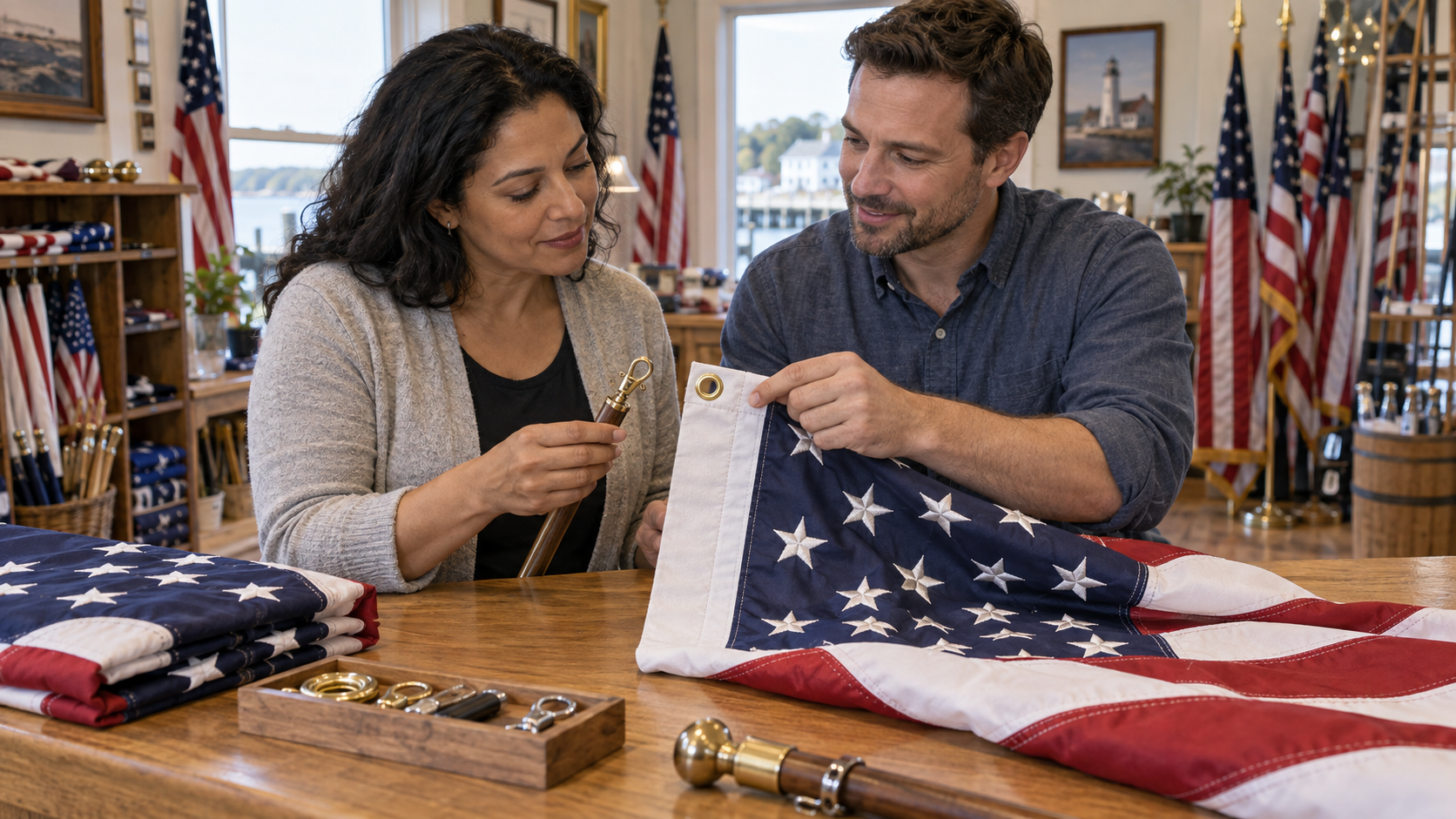
Treat indoor finishing as a separate decision. A flag with a header and grommets is not automatically the correct replacement for a display staff that requires a pole sleeve and retaining tab.
Before ordering, record the existing flag’s dimensions and photograph how it attaches.
A Ceremony or Presentation With Specific Requirements
For ceremonial organizations, begin with the equipment and any applicable organizational specifications. Then compare star construction.
An attractive flag that fits poorly on the staff creates an avoidable problem. Ask about the complete flag-and-equipment combination rather than assuming that an embroidered product is automatically ceremony-ready.
When Printed Stars May Be the Right Purchase
Printed stars deserve consideration when the particular flag’s intended use, appearance, and price match your plans.
An occasional display buyer may reasonably select a printed product designated for that use. Someone choosing a commemorative design may prefer its artwork and material without needing raised embroidery.
The important question is whether the product matches the job. An inexpensive purchase becomes poor value when it is used beyond its intended application; a more elaborate purchase may add little value when the buyer never sees its decorative detail.
World of Flags’ buying recommendation: consider normal viewing distance before paying extra for a close-range feature. Look at the flag from where it will actually be seen, then decide how much the texture matters to you.
This is a practical decision aid, not a measured visibility threshold. Lighting, movement, eyesight, and flag size all affect what someone notices.
American flags at World of Flags USA
Three Buyers, Three Different Decisions
These examples are illustrative, not customer case studies.
The homeowner with a sheltered porch: A buyer wants a traditional flag beside the entrance and likes seeing the stitchwork up close. An embroidered option is worth comparing, provided the material and attachments fit the display.
The community group planning occasional displays: The group has a limited budget and a clearly defined flying schedule. A printed product intended for that application may meet its needs. Verify specifications and origin rather than rejecting printing automatically.
The organization replacing an indoor flag: Staff want a polished appearance beside a lectern. They should compare embroidery and overall presentation, but also measure the sleeve and confirm the staff connection. Matching the equipment is part of the purchase.
The lesson is not that every group should buy a different star type. It is that the same feature can have different value in different settings.

Embroidered Stars, Sewn Stripes, and Appliqué Are Different Terms
“Embroidered stars” describes the canton. “Sewn stripes” describes how the red and white stripes are assembled. Check both rather than allowing one detail to stand in for the other.
For the broader construction comparison, read Printed vs. Sewn American Flags: What Is the Difference?.
Appliqué is another star-making method: separate fabric shapes are attached to the field. Embroidery forms the shape with stitches. If a listing uses the broad phrase “sewn stars,” ask which method it means.
Do not infer that a flag lacking embroidered stars lacks craftsmanship. Evaluate the method specified for that exact product.
Also explore flag sets and poles
How to Compare Two Flags Without Being Misled
Start with a short checklist:
- Size: Compare the same dimensions.
- Application: Indoor display, occasional outdoor display, or regular outdoor flying?
- Material: Identify the fiber and the actual product line.
- Stars and stripes: Confirm each construction detail separately.
- Finishing: Check hems, fly-end reinforcement, and header.
- Attachment: Confirm compatibility with the pole or staff.
- Origin: Verify labeling and manufacturer information.
- Care: Read the product’s instructions.
Avoid treating a difference in price as the isolated cost of embroidery. Two flags may also differ in fabric, finishing, packaging, or intended use.
For an organization ordering several flags, write those requirements into the order description. A repeatable specification is more useful than asking different purchasers to find something that “looks premium.”
Made in the USA Is a Separate Question
Both printed and embroidered American flags can be made domestically. Neither construction method establishes origin.
Look for product-specific manufacturer information and documented country of origin. FMAA also provides a Made in the USA certification program; check the actual product’s certification information rather than assuming it from a retailer’s membership.
World of Flags USA is a family-owned Maine business sourcing American flags from U.S. manufacturers. Browse American flags.
Also Read: Learn about World of Flags USA
Common Myths About American Flag Stars
“Embroidered means weatherproof.”
Embroidery is a construction detail. Ask about the complete product and actual exposure.
“Printed means imported.”
Origin must be verified separately from the manufacturing method.
“Sewn stripes guarantee embroidered stars.”
They describe different parts of a flag. Read both specifications.
“The most expensive flag is right for every location.”
Price cannot establish compatibility with a pole or suitability for your intended use.
“A close-up photograph tells me how the flag will look on my property.”
It shows a detail. Your normal viewing distance, lighting, and display setting determine how much that detail matters.
Care Still Matters After You Choose
Keep either type of flag clear of surfaces that can catch or abrade it. Inspect it regularly, especially after challenging weather, and follow its manufacturer’s cleaning instructions.
Eder specifically advises avoiding contact with rough surfaces and inspecting for wear. Its guidance also explains that exposure to harsh weather affects service life. Read its flag-care guidance.
Do not assume that embroidery makes a flag immune to damage, or that a generic cleaning method is suitable for every material. Consider origin, construction, exposure, and maintenance together when assessing value.
Frequently Asked Questions
1. What Is the Difference Between Embroidered and Printed Stars?
Embroidered stars are formed with thread stitched into the blue field. Printed stars are part of a printed or dyed design, without raised embroidery. The difference affects texture and appearance but does not establish the quality of the entire flag.
2. Are Embroidered Stars Better for a Residential American Flag?
They can be a good choice when you want a traditional, textured appearance, especially on a porch or near an entrance. Confirm that the flag’s material, size, and attachment method also suit your display.
3. Do Embroidered Stars Make a Flag Last Longer?
Embroidered stars alone do not establish a longer lifespan. Fabric, seams, fly-end reinforcement, sun exposure, wind, contact with nearby surfaces, and care all influence how a flag wears.
4. Are Printed-Star Flags Only for Temporary Use?
No. Some printed flags are intended for occasional or seasonal display, while other products use materials and finishing for different applications. Check the manufacturer’s intended use rather than judging by star construction alone.
5. Can a Printed American Flag Be Made in the USA?
Yes. Printing and country of origin are separate attributes. Verify the manufacturer, product labeling, and documented origin instead of assuming that printed stars mean imported construction.
6. Does Embroidered Stars Mean the Stripes Are Sewn?
No. Many flags combine embroidered stars with sewn stripes, but these describe different parts of construction. Confirm both details in the specific product description.
7. Which Stars Look Better for Indoor and Ceremonial Displays?
Embroidered stars are worth considering when texture and presentation matter at close range. Also check the flag’s dimensions, pole sleeve, tabs, and compatibility with the intended indoor or parade equipment.
8. Are Embroidered Stars the Same as Appliquéd Stars?
No. Embroidery forms the star with stitches. Appliqué attaches a separate fabric star to the blue field. Read the specific construction description because both may be described broadly as sewn stars.
9. How Can I Compare Two Flags Fairly?
Compare the same size and intended use, then check material, star construction, stripe construction, fly-end finishing, header, attachment method, origin, and care instructions. A difference in price may reflect several specifications rather than embroidery alone.
10. Can World of Flags USA Help Me Choose?
Yes. Contact World of Flags USA at 207-262-8275 or info@woflags.com with your flag size, display location, pole or staff details, and preferences. Ask for help comparing suitable American-made options.
What You Should Do Next
You do not have to become a flag-manufacturing expert to make a thoughtful purchase. Start with where the flag will go, how often it will be displayed, and what appearance you want.
Measure your existing flag, check its attachment method, and take a photograph of the pole or staff. Then compare suitable products and decide whether embroidered texture is something you will enjoy.
If you are uncertain, bring those details to World of Flags USA. A clear conversation can help you avoid an incompatible replacement and choose an American-made flag that fits the way you intend to display it.
Choose with confidence, display with pride, and ask for help before a small specification becomes a purchasing mistake.
Compare American-made flags with World of Flags USA and get help matching the material, construction, size, and attachments to your home or organization.
Read Last Article Here: https://woflags.com/printed-vs-sewn-american-flags/