What Makes an American Flag Truly Made in the USA?
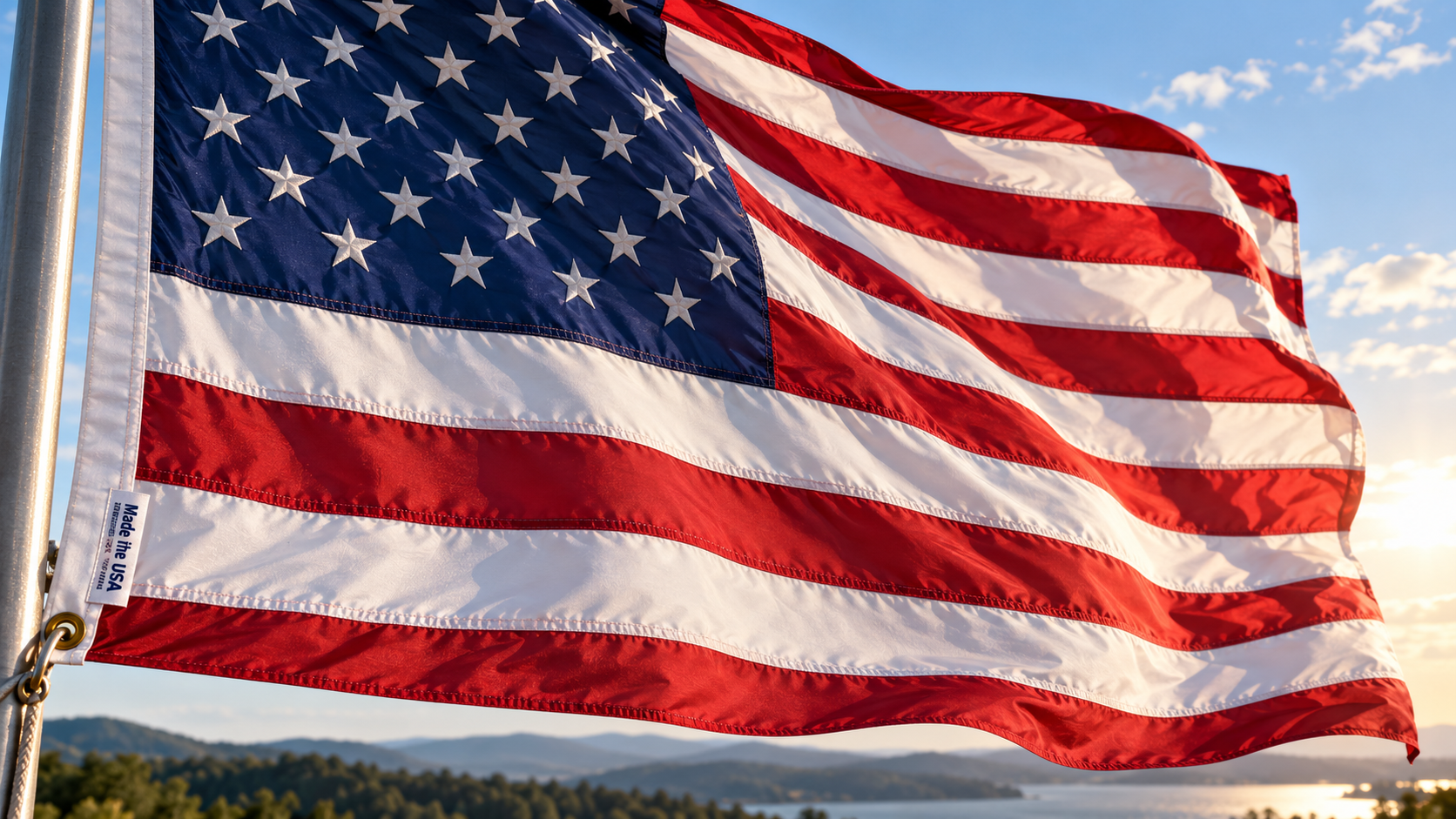
An American flag can carry powerful meaning long before anyone asks where it was made. It may hang outside a family home, fly above a veterans’ memorial, or represent an organization at a public ceremony. For buyers who want that symbol to support American workers and domestic manufacturing, the image on the fabric is only the beginning. Where was the flag made, and where did its materials come from?
The answer takes more than spotting a familiar brand or a red, white, and blue product photograph. Fabric may be made in one country, printed in another, sewn in a third, and shipped from an American warehouse. Understanding those steps helps patriotic consumers buy with confidence and helps procurement teams write requirements that suppliers can document.
“American flag” describes the design, not the origin
The stars and stripes identify the flag of the United States. They do not tell you where a particular flag was manufactured. An American company can sell an imported flag, and an American address on a package can belong to a distributor rather than the factory.
The Federal Trade Commission (FTC) advises flag shoppers to check origin labeling. It also warns that “ships from the USA” does not establish where a flag was made. A domestic fulfillment center may help with delivery, but it is not evidence of domestic production.
That distinction matters in bulk purchasing, too. A quote from a U.S. vendor may include flags from several manufacturers with different sourcing. Ask about the specific product and manufacturer, not merely the seller’s headquarters.
What does “Made in USA” mean to consumers?
For an unqualified “Made in USA” claim, the FTC’s general standard is “all or virtually all” made in the United States. Final assembly or processing must occur here, all significant processing must occur here, and foreign ingredients or components must be absent or negligible. The FTC considers the significance of foreign content as well as its cost; there is no universal percentage shortcut that makes every product eligible for an unqualified claim.
For a flag, the sewing location is an important question, but it should not be the only one. Ask where the fabric was produced and finished, where printing or embroidery occurred, and where assembly took place. The origin of significant components deserves attention as well. A seller making a broad origin claim should have reliable information to support it, including information from suppliers.
Different wording conveys different information. “Printed in the USA” identifies one operation. “Sewn in the USA from imported fabric” tells you both where the sewing happened and a meaningful limit on domestic content. Neither statement automatically establishes that the entire flag qualifies for an unqualified “Made in USA” claim. The FTC also explains that certain textile products have specific labeling rules, so purchasing staff should review the applicable label and obtain documentation instead of assuming one slogan resolves every requirement.
Guidelines for Sizing Your Flag for Display
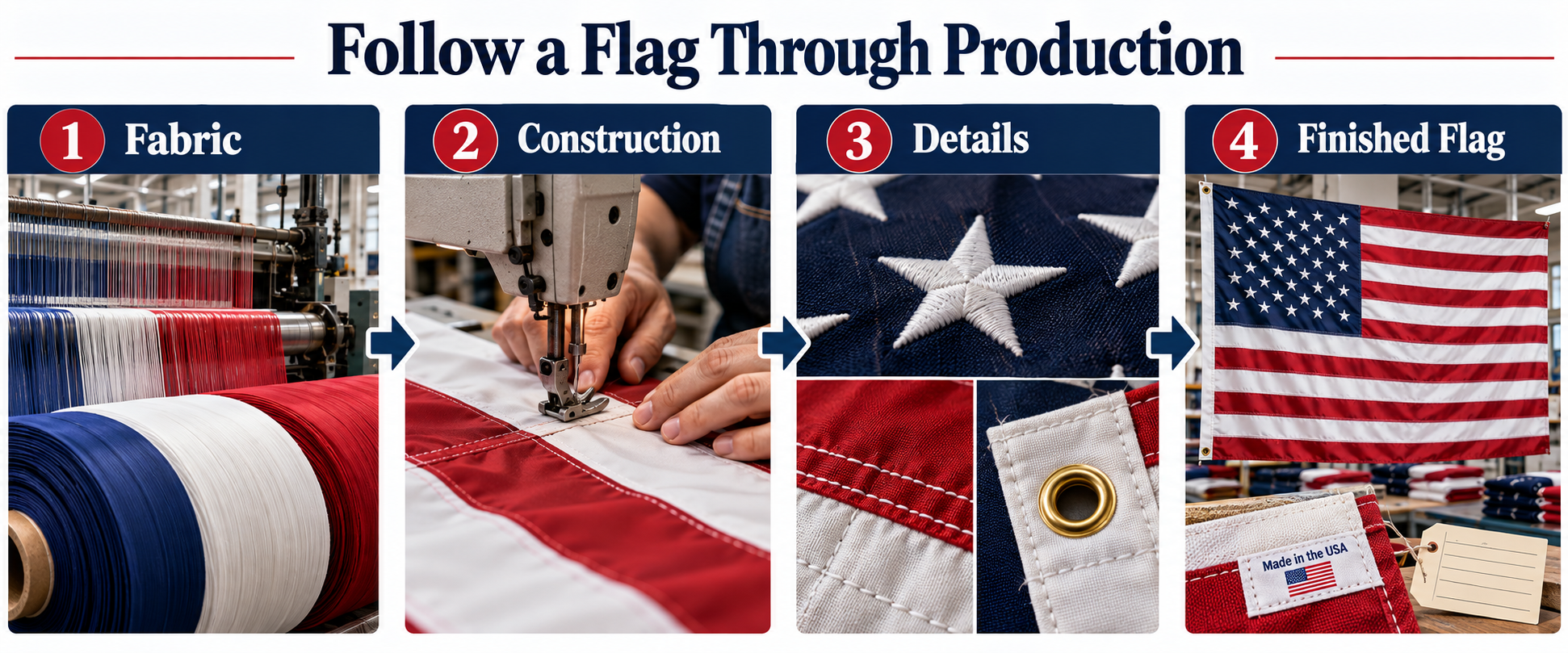
Follow the flag through production
A useful way to evaluate origin is to trace the product from material to finished flag:
- Fabric: Where was the yarn made or the fabric woven? Where was the fabric dyed, bleached, or printed?
- Construction: Where were the fabric panels cut and the flag assembled and sewn? For a printed flag, where did printing and finishing occur?
- Details: What is known about the stars, stitching, heading, grommets, and other significant components?
- Finished item: Which manufacturer made this exact style and size, and what origin claim appears on its label or packaging?
These questions do not mean every American made flag has the same construction. Sewn stripes, embroidered stars, and printed designs can all serve legitimate uses. Construction quality and country of origin are separate questions. A sturdy hem or bright color may tell you something about workmanship; it cannot prove the supply chain. Likewise, a low price alone cannot prove that a flag was imported. Request evidence for the product you are buying.
| American Flags Guide |
What does the FMAA certification seal tell you?
The Flag Manufacturers Association of America (FMAA) runs a certification program for qualifying flags. Its published requirements call for certified flags to be produced entirely in the United States. They specify that fabric weaving, dyeing or printing, cutting, assembly, sewing, finishing, and packaging take place in U.S. facilities. Participating manufacturers must obtain origin certificates from raw-material suppliers and keep them on file. Certified flags must carry the official seal, which identifies the certified manufacturer.
That makes the seal a useful buying signal, especially when a purchaser wants more than a generic marketing statement. Still, check the particular flag, its packaging, and the manufacturer named on the seal. Membership in a trade association or a retailer’s relationship with certified manufacturers does not, by itself, establish that every item in a catalog carries the certification. For a large order, request product-specific confirmation and keep it with the purchase record.
How Many Stars Are On The American Flag, And What Do They Represent?
Federal flag purchases have a distinct rule
Federal procurement staff have another standard to consider. The All-American Flag Act, enacted in 2024 and codified at 41 U.S.C. § 6310, generally bars covered executive agencies from using available funds to buy U.S. flags unless the flags are 100 percent manufactured in the United States from articles, materials, or supplies grown or 100 percent produced or manufactured here. The provision applies to contracts entered into beginning 180 days after enactment.
The law contains exceptions, including purchases below the simplified acquisition threshold, specified purchases by vessels in foreign waters, certain resale purchases, and an agency-head determination concerning availability at U.S. market prices. It also provides for a presidential trade-agreement waiver. Whether a purchase is covered depends on the buyer and the transaction, so a federal team should use its contracting office’s current instructions and request evidence that addresses the statute’s actual language.
An FTC consumer-facing “Made in USA” claim and compliance with this federal purchasing rule are different questions. The federal statute uses a 100 percent manufacturing and materials requirement for covered purchases. A vendor’s product page or certification seal may be helpful evidence, but the purchasing team should ask the supplier to confirm the precise specification in the solicitation. State, municipal, school, nonprofit, and corporate purchasers should check their own policies and contract terms; the federal statute does not automatically govern all of them.
How The USA Flag Became A National Icon Of Unity And Freedom?
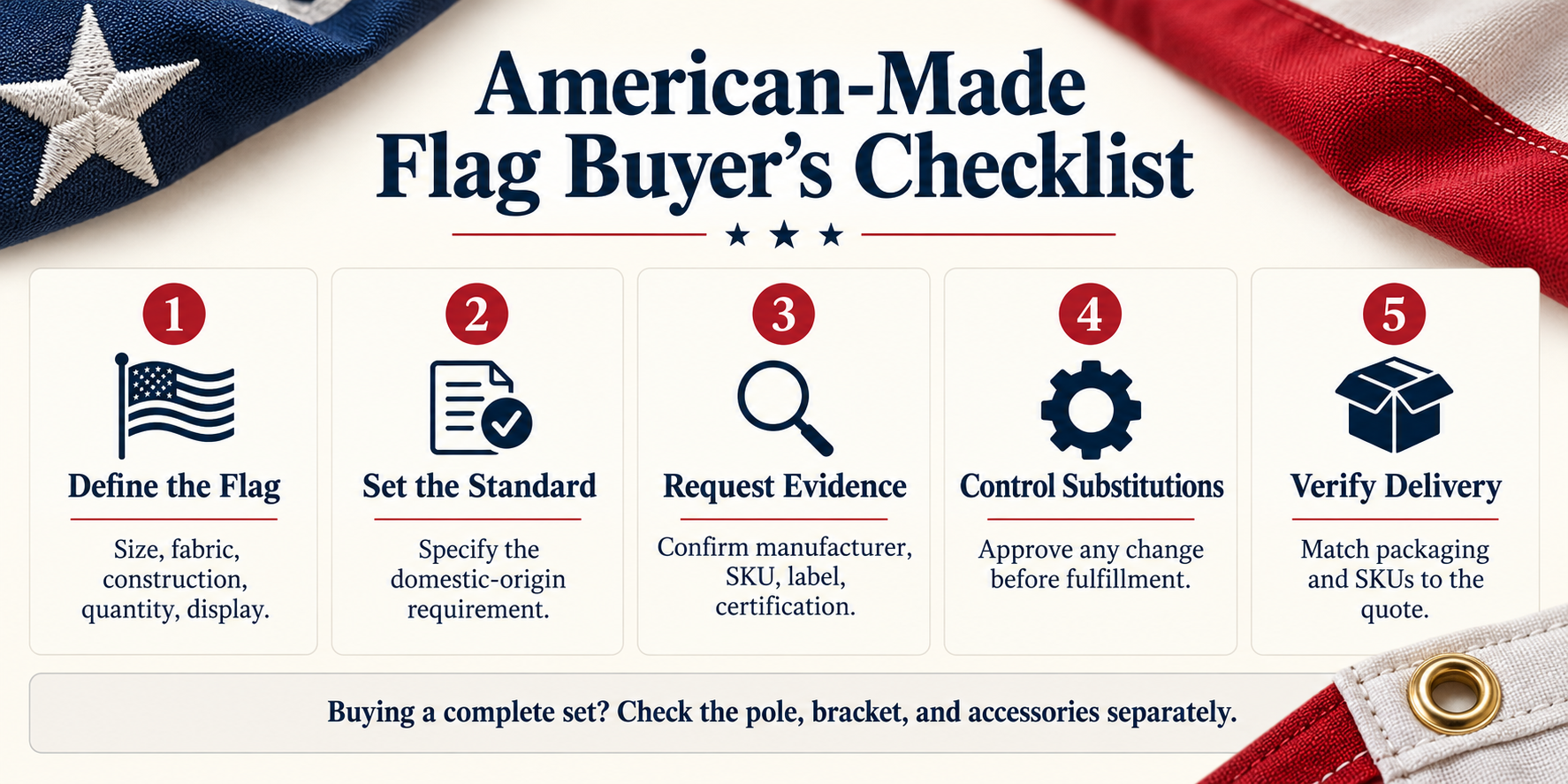
A practical checklist for buyers and procurement teams
If you are buying one flag for home, start with the product label, the named manufacturer, and an explicit origin statement. If those details are missing online, ask the seller before ordering. The FTC recommends checking the seller’s reputation as well as its claims.
For an organization buying dozens or hundreds of flags, make the request more precise:
- Define the item: State the size, fabric, construction, intended display, quantity, and any hardware or accessories.
- State the sourcing standard: Specify whether you require a substantiated consumer “Made in USA” claim, FMAA certified flags, a particular domestic-content requirement, or compliance with the All-American Flag Act for a covered federal purchase.
- Ask for product-level evidence: Request the manufacturer, model or SKU, origin statement, applicable certification, and written confirmation for the exact items quoted.
- Address substitutions: Require approval before a different manufacturer, fabric, style, or country-of-origin claim replaces the quoted item.
- Check the delivery: Compare packaging, labels, quantities, and SKUs with the approved quote; retain the supporting records.
Remember to specify accessories separately. A flag, pole, bracket, and decorative topper are different products with potentially different supply chains. A domestic-origin claim for the flag does not automatically cover a complete display kit. If every component must be domestically sourced, say so in the request for quotation.
Why domestic sourcing is worth asking about
For many families, choosing an American made flag is an expression of the same values that prompt them to fly it. For veterans’ groups and civic organizations, clear sourcing can reflect the care they put into a ceremony. For procurement teams, a specific, documented requirement makes bids easier to compare and deliveries easier to verify.
Domestic sourcing does not remove the need to choose the right flag for the setting. A residential porch, a windy commercial site, an indoor stage, and a memorial display may call for different sizes, fabrics, and construction. Origin is one decision; fit for use is another. A good supplier should help you answer both with a clear claim about the product you choose.
How To Light Your Flag At Night?
World of Flags USA is a family owned flag dealer and manufacturer in Bangor, Maine. We source our flags from U.S. manufacturers and are a member of the FMAA. We offer American flags and flag display products for individuals and organizations. Because requirements vary by product and purchase, tell the team exactly what domestic-origin standard you need and ask them to identify the matching flag you need today.
Explore World of Flags’ American flags or call 207-262-8275 to discuss a household display, a ceremonial order, or an organization’s sourcing requirements. A flag means more when you know the story behind the one you choose.